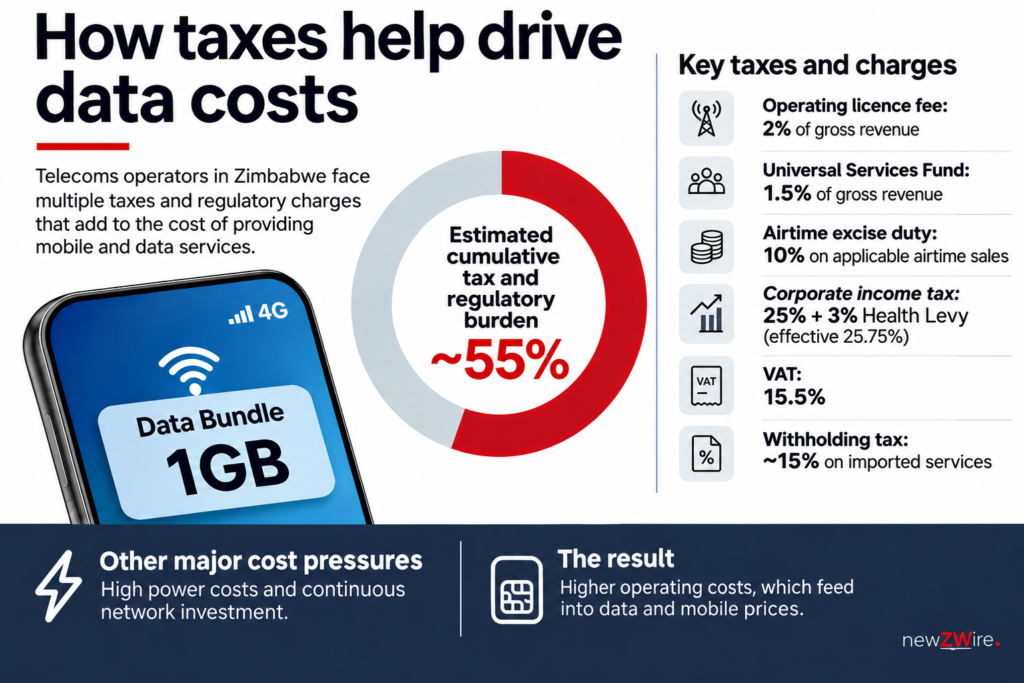










The cost of staying connected in Zimbabwe is impacted by a combination of taxes, regulatory charges and high operating costs, with telecommunication operators carrying an estimated government tax burden of around 55%.
The multiple charges add to the cost of providing mobile and data services, putting pressure on operators’ capacity to provide affordable services for consumers and, in many ways, affecting the quality of service delivery to customers.
Industry data shows the range of taxes telecoms operators face.
Each month, an operator typically pays licence fees equivalent to 2% of gross revenue. This is alongside a 1.5% contribution to the Universal Services Fund (USF), a special fund used to roll out network infrastructure to underserved areas. These are areas that are home to communities that need vital telecom services, but are not economically viable for operators to extend coverage to.
Operators also pay a 10% special excise duty on applicable airtime sales. In addition they pay spectrum fees, which vary depending on the allocation.
On profits, companies pay corporate income tax of 25%, plus a 3% Health levy, bringing the effective rate to 25.75%. VAT is charged at 15.5%, while withholding taxes on imported services are reported to be around 15%, depending on the nature of the service.
There is also a numbering fee that telecom operators pay, which is pegged at US$0.05 for every number.
Beyond taxation, operators have to contend with high operating costs, such as electricity costs, and the expense of maintaining backup power systems to keep services up and networks running.
They also face substantial costs associated with importing network equipment, maintaining infrastructure and expanding coverage.
An industry expert says the combination of these costs puts considerable pressure on operators.
“Running a telecoms business is expensive. You have to keep investing in infrastructure, pay high bills and maintain backup power, all while dealing with multiple taxes and regulatory charges. At the end of the day, all these costs put pressure on the price of keeping people connected and offering reasonable service quality, even though the public only sees and feels the end user price,” the expert said.
The estimated 55% cumulative burden highlights the range of statutory obligations operators must factor into their overall operating costs and investment decisions, at a time when affordable connectivity is increasingly important for households and businesses, and the adoption of new digital technologies in business and everyday life is no longer a luxury, but a vital necessity.