







By Ritesh Anand – International Investor
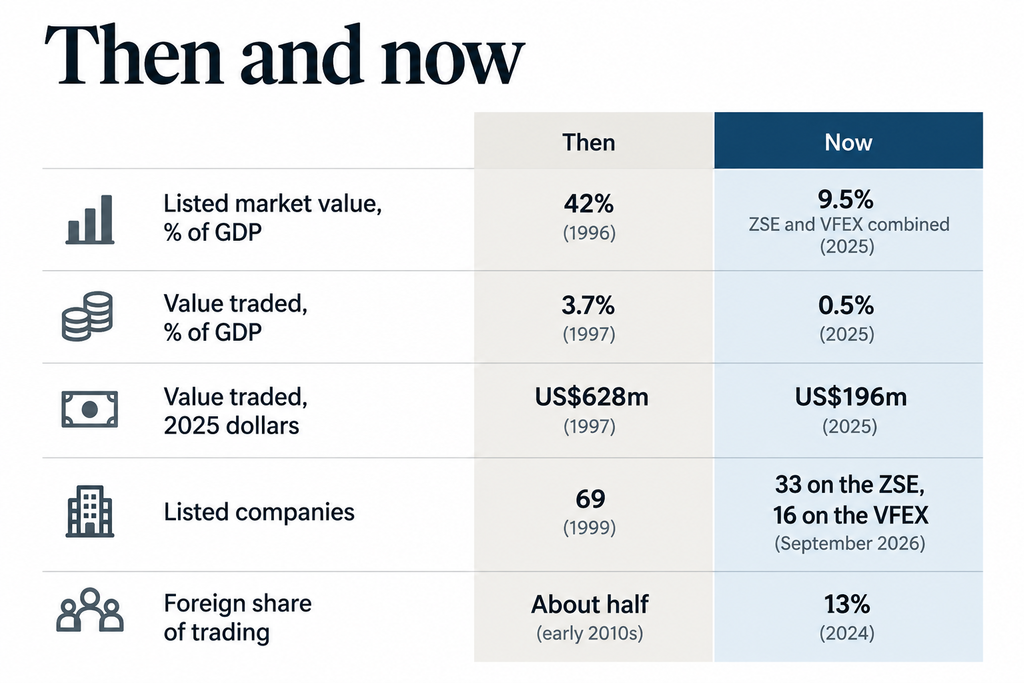
In 1996, the Zimbabwe Stock Exchange (ZSE) was one of Africa’s most exciting markets. In today’s dollars, it now trades less than a third of what it did then. Here is how that happened and how to bring it back.
My phone used to start ringing at seven in the morning.
In 1998, I was managing unit trusts at First Mutual Life. The ZSE still traded by call-over, twice a day, at 10am and 2pm. The phone started at seven and never really stopped ringing. Soon after the first, and we started all over again for the second. More than 25 brokers rang me every day, and I knew every one of them. I was at my desk by half past six and rarely left before ten at night.
Then, in September 1998, Econet listed. I bought at Z$1 and sold at Z$57 within weeks. Realising my mistake, I bought back at Z$60 and sold at Z$70. At one point, Econet was about a third of my little chip equity fund, which finished the year as Zimbabwe’s best-performing unit trust, up more than 300%. I was 25 years old and the leading fund manager in Zimbabwe. It was the foundation of my career.
What I remember most is not the returns. It is the hunger. Brokers, fund managers, companies and foreign investors fought for every share. The exchange was where Zimbabwe priced its future, and the whole country seemed to be on the line.
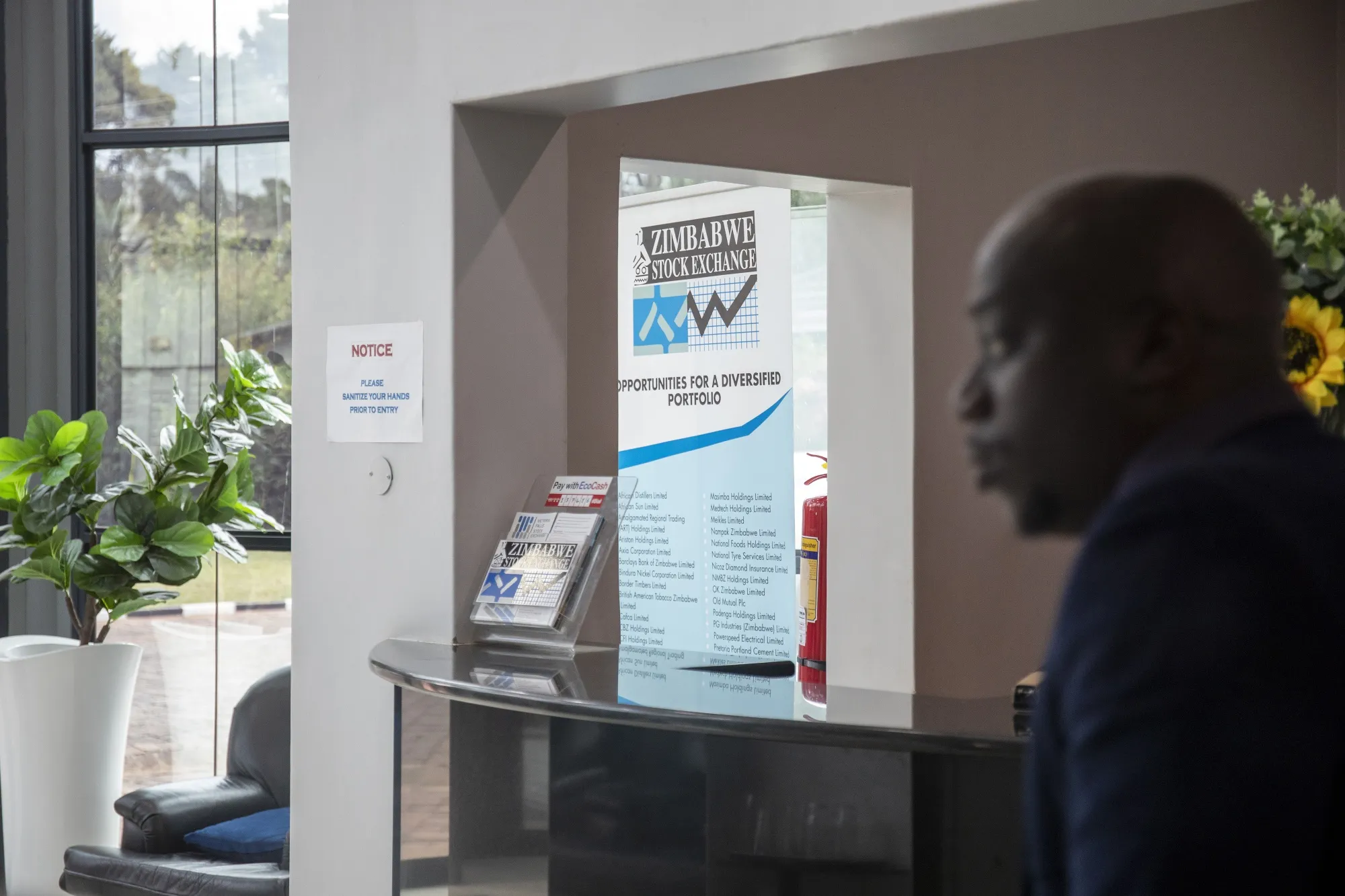
The call-over gave way to trading screens long ago. The ZSE went fully electronic in 2015. No fund manager’s phone rings like that any more, and that is progress. The problem is that the screens have gone quiet too.
Market interest
In 1997, the ZSE traded US$513 million worth of shares. In today’s money that is about US$628 million. In 2025, it traded US$196 million, in an economy now officially valued at US$59.7 billion.
The board is emptying
Fifteen companies have left outright since 2020, most citing the same reasons: prices detached from value, shares that barely trade, and a listing that can no longer raise money.
There has been one public share offer in almost six years. In March, Econet itself left. The stock that once electrified the market, and made my early career, walked away saying the ZSE valued it at under a quarter of its worth.
What remains is thin and concentrated. Five counters made up 94% of value traded in the first quarter. On September 1, 2026, 13 of the 33 companies on the ZSE did not trade at all and the ZSE and VFEX together traded US$1.6 million: less than a third of an average ZSE day in January 2019. The Nairobi Stock Exchange trades about US$4.5 million a day; Harare, about US$800,000.
Foreign investors, once half the market, are now heading for the door. In the last quarter of 2025, they supplied almost half of all selling and just 1.5% of the buying.
The exchange’s defenders will say the ZSE has been Africa’s best-performing market in dollar terms this year, and that first-half turnover across both exchanges hit a record US$459 million. Both are true. Both mislead.
Prices have bounced from a very low base and an index only tracks the survivors. Much of that turnover came from Econet’s exit. In April, ZSE turnover fell 84%. A market that comes alive mainly when a company is leaving is not a healthy market.
How we got here
Zimbabwe has lived through half a dozen currency regimes since the late 1990s. Every collapse erased capital and confidence, and only part of it came back.
In 2020, the government shut the ZSE for five weeks, in effect for revealing an exchange rate. Old Mutual stayed suspended for five years.
Today, the ZSE prices companies in local currency, ZiG, while by the RBZ’s own count, more than 80% of transactions are settled in US dollars. Investments respond the only way they can. They discount every share.
Economy that moved the goalposts
Zimbabwe’s first economic census found that 76% of economic activity is informal. Just over a third of working people hold formal jobs. Listed companies are drawn from the formal, audited, tax-paying economy and that economy has shrunk relative to everything around it.
Gold exports hit a record US$6.1 billion in 2025, about 40% of everything Zimbabwe sold abroad, and US$4.6 billion in the first eight months of this year alone. Minerals represented three-quarters of export earnings. Small-scale miners produce about 75% of the gold. Diaspora remittances brought in US$2.45 billion, almost ten times higher than FDI. Hardly any of that money passes through the stock exchange.
The VFEX, trading in US dollars at lower cost, has given companies an escape route. Innscor, Simbisa, Padenga, First Capital Bank, TSL and now Old Mutual, have moved there. But the VFEX has mostly relocated existing companies rather than raise new capital. Some firms are now leaving it too. The cost of all this is not paid only by brokers. Companies that cannot easily borrow short or stand still. Pension savings pile into property because the listed market is too small to absorb them.
The state has no credible price for the assets it wants to sell. And the privatised gold windfall in our history risks allowing straight into imports and offshore accounts, leaving no domestic capital market behind. That is the resource curse in its most familiar form.
Seven ways to wake the market up
This decline was made by policy. So, policy can reverse it. Most of what is needed costs the Treasury little or nothing.
– Let ZSE shares settle in either currency: Allow equities to settle in US dollars or ZiG at the investor’s election, with price discovery remaining on a single order book and exit offers payable in either currency, until the Reserve Bank’s own conditions for a single currency are met. With the bulk of the economy’s liquidity held in dollars, this would draw that capital onto the screen without forcing a conversion at the door. There is a clear precedent for this. Global settlement houses routinely settle trades in a currency other than the price currency. Nairobi is building a dollar settlement route for its exchange, and Zimbabwe already settles in dollars on the VFEX.
– Make repatriation a rule, not a favour: Publish a fixed timetable for remitting foreign investors’ dividends and sale proceeds, clear the backlog on a published schedule, and promise never again to close the market for revealing an exchange rate.
– Cut the cost of trading: A round trip on the ZSE costs about 4.2%, against 2.15% on the VFEX. Start by scrapping the withholding tax on gross sale proceeds, which is charged whether or not the investor made a gain.
– Let what the state owns: Sell minority stakes in state and Mutapa-held businesses through public offers on the exchange, with a tranche reserved for ordinary savers.
– Turn gold into a listed asset: Create a listed gold royalty or gold-backed fund, and make listed vehicles the route to local ownership in large mining projects, so that part of the windfall stays at home in a form Zimbabweans can own.
– Bring the institutions back to the screen: Let listed infrastructure bonds and equities count towards pension funds’ prescribed assets. License market makers in the 20 largest counters, and make every block trade public the same day.
– Protect the small shareholder: Require any delisting to be approved by a majority of the shares the controlling holder does not own, set an independent valuation floor under exit prices, and make delisting public at 5%.
Then set public targets and report against them. Listed companies worth 25% of GDP by 2030, and ten new listings, at least five of them genuine share offers.
The moment is now
There has rarely been a better time. ZiG has been broadly stable since its late-2024 devaluation, ZiG inflation is in single digits, the government is meeting the targets of its IMF staff-monitored programme, and gold is bringing in more hard currency than at any time since Independence. Stability is the precondition for a revival. It is not proof of one.
The gold price will not stay this high forever. Zimbabwe can let this boom pass through without leaving a capital market behind, or it can use it to rebuild one. I learned my trade in a market that was hungry, crowded and alive.
It would be a sad irony if the obituary of a 130-year-old exchange were written in the very decade the country finally has dollars to invest.
The phones will never ring like that again; the call-over belongs to history. But Zimbabwe deserves trading screens as busy as those phones once were.
Ritesh Anand is an international investor. He began his career as a fund manager in Zimbabwe. He writes in a personal capacity and the views expressed are his own and do not represent those of any employer.