




By Farai Shawn Matiashe
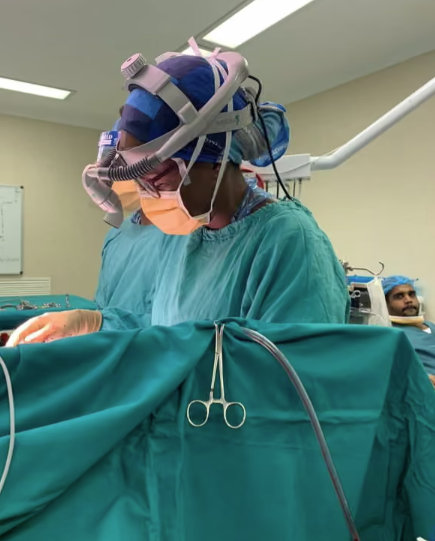
When Dr Kudzai Kanyepi qualified as Zimbabwe’s first female cardiothoracic surgeon four years ago, she was filled with pride and anticipation after succeeding in an area long dominated by men. She was only the 12th woman in Africa to qualify in the field – four more have joined her since.
Even now, with 100 operations under her belt, the reality of working in a role in which she confronts misogyny and discrimination daily has not dented Kanyepi’s love of the surgical theatre.
In South Africa, where she trained as a heart surgeon, she had been among other women medics, but when she returned home to Zimbabwe, she joined a tiny group of just four other cardiothoracic surgeons in the country, all of whom were male.
“I was first treated with scepticism,” she says. “Misogyny was not always said outright, but people had doubts. Everything was about proving myself again.”
____
Kanyepi grew up in Harare, and says she was lucky that her mother was able to send her to some of the city’s best schools. But it was a fluke that led her to turn to medicine.
At the National University of Science and Technology in Bulawayo, she enrolled to study electronic engineering. But that class was full, and the university could only accommodate her in medical classes. Her interest was ignited, and before long, Kanyepi had transferred to the University of Zimbabwe to study for the degree her mother had always secretly believed she was destined for: medicine.
In 2017, she moved to South Africa to train as a heart surgeon at Inkosi Albert Luthuli Central Hospital in Durban. “I remember the day I walked into the hospital. That was when my life changed,” she says.
Africa has a history of pioneering heart surgery. It was in Cape Town that Christiaan Barnard performed the world’s first human-to-human heart transplant in 1967. But despite cardiovascular disease being the leading cause of death globally, responsible for 19.8 million deaths in 2022 – 80% of which occur in low- and middle-income countries, including in Africa – cardiothoracic surgery is high cost and unavailable in many countries, and there are continent-wide shortages of skilled surgeons and doctors.
Dr Rajhmun Madansein, the head of cardiothoracic surgery at Inkosi, who trained Kanyepi, had also taught Lindiwe Sidali, South Africa’s first African female cardiothoracic surgeon. Sidali, who qualified in 2018, became an inspiration and mentor for Kanyepi. “Whenever we needed to be put straight, Lindiwe was the big sister,” she says.

___
Kanyepi had just become a mother when she began her surgical training, having arrived in Durban nine months pregnant. “It was difficult to balance training and motherhood,” she says. “But I had extremely strong family support – my mother. This allowed me to continue to pursue heart surgery.
“I had to do as much as men when I was training. When I came back, I had to [do] double the amount of work as my male colleagues to prove that I know what I am doing.”
Even so, she adds: “In the private practice, there are people who simply do not refer [patients] to me because I am a woman. And they do not think the calibre of training I received is the same. There is this misconception that women have it easier.”
Kanyepi says this is the downside of being a pioneer in her field in Zimbabwe. “When people talk about the first female, they think it is all glamour, glory and excitement. But there is always the other side. You have to navigate being the only one,” she says.



