




Common Law with Mike Murenzvi
“The decision to have an abortion is a deeply personal decision between a woman, her family, her doctor, her God; not her government, and not the public at large.” – Margaret Hoover.
Following Parliament’s Easter break, debate on a motion moved by Sen. Bertha Chinyanga and Sen. Annah Rungani to expand safe abortion access continued in the Senate.
The motion arises partly from a November 2024 High Court ruling that the definition of unlawful intercourse in the Termination of Pregnancy Act (TOPA) was too narrow and unconstitutional. The Senate is currently debating a motion to ensure that the necessary changes are made to the law, plus some expansion.
[See also: Zimbabwe’s Abortion Law Debate: Between Public Health, Rights and Religion
COLUMN | After landmark ruling, a major update is coming to Zimbabwe’s Abortion Law]
Subsequent debate
Debate Day 4 – 7 May 2025
Sen. Chief Ngungumbane (Male) (Chief) opposed the motion on several grounds. Firstly, on the terminology used in the motion, specifically, that it should have stated the “termination of unwanted pregnancy” instead of abortion. He opined that the term abortion refers to an illegal, clandestine procedure.
Secondly, he expressed shock and dismay that some female senators were in support of a motion that would encourage girls to enjoy premarital sex and further burden our healthcare system. “If we legalise abortion because most girls and women are doing it, we are not addressing the problem. The problem is the erosion of societal norms and values in our country. That is what we should be strengthening to address this problem,” he stated. Furthermore, he equated allowing abortions to allowing criminality.
Thirdly, he brought up the Constitution, specifically section 48, which discusses the right to life. During the Constitution-making process, Zimbabweans were very clear in saying, “do not legalise abortion”. He further hammered on the point that Parliament and the President had recently enacted the Death Penalty Abolition Act, and now, paradoxically, they were seeking to introduce the death penalty by other means.
Fourthly, he was against the importation of foreign values into the country. He gave an example of South Africa, where abortion is legal, where a woman can choose to have an abortion without consulting her partner. This goes against all our cultural norms in Zimbabwe and should be discouraged as it will go on to destroy the institution of marriage.
Fifthly, His view is for Parliament to narrow down on the High Court judgment and, more specifically, the definition of unlawful intercourse, and if Parliament is not in agreement, the President can step in with temporary measures as happened with the age of sexual consent.
He ended his submissions with Exodus 20 verse 13 (the Ten Commandments), “thou shalt not kill,” equating murder and abortion, and both should suffer the same consequences.
Sen. Kudakwashe Matibiri (M) (CCC) was so moved by Chief Ngungumbane’s contributions that he sought to postpone his own debate to a later date. “It is not because I am shying away from the debate, but I think I need to do justice, and I am seeking that indulgence to prepare myself adequately.”
Sen. Omega Hungwe (Female) (ZANU-PF), against the motion, began by invoking song lyrics from Mambo Dhuterere that say the blood of that which you have aborted will be crying because it is a person. Her submissions were largely on religious grounds, where she declared that Zimbabwe was a Christian nation and must act in line with the Ten Commandments, especially thou shalt not kill. Furthermore, she accused the movers of the motion of not doing enough research before tabling it as this would have led them to abandon it from the onset and stated that passing this motion would make Zimbabwe a laughingstock.
“We need to remember that the laws that we pass as Parliament should not be a legacy of failure and the 10th Parliament should not be remembered as one that agreed to pass a law allowing killing.”
She ended her debate by saying, “We do not want to adopt laws from other countries. If you look at our neighbouring country, prostitution is there, and it comes with diseases because if I get pregnant, I can abort and find another man. What we are saying is that Zimbabwe is a Christian country which has its own morals and our ancestors who are very good, who do not want us to kill people.”
Running score
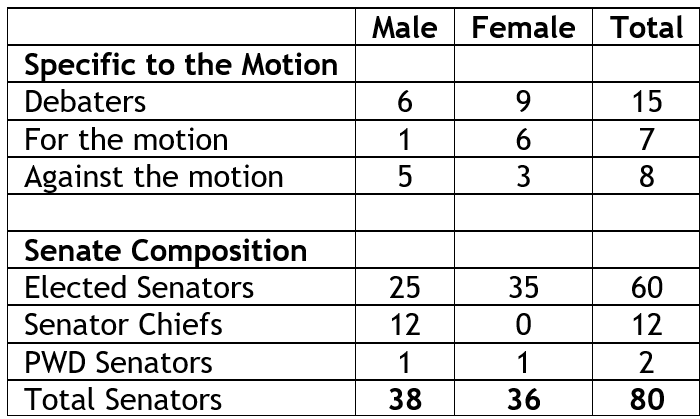
This week’s debate on the motion saw very strong opposing contributions couched on religious, cultural, and ideological grounds. As of this week, 15 Senators have contributed to the debate with 8 against and 7 for the motion.
Missing points
While contributors have been framing their arguments around religion, ideology, and health, the legal problems of the TOPA in its current form have largely been ignored. Perhaps it is because the motion seeks mainly to expand access to abortion services, and this is overshadowing all debate.
Senators still to debate would do well to expand their arguments beyond their personal feelings to address the real issues. Needless to say, this debate is foreshadowing future amendments to the TOPA that shall go through similar debate when Parliament now debates the content and language of the future Bill. Through following this debate, the framers of the future Bill can get an idea of what’s likely to pass and what will be subject to intense debate and possible change or removal.
I expect more Senators to take to the floor in the coming weeks as this debate is far from complete. However, in terms of points of argument, most have already been made in one way or another and this may lead to a premature closure of the debate and forcing of a vote. Given the closeness of opposing views, a vote on the motion may require actual voting and not the standard acclamation of aye or nay.
_______________________
Mike Murenzvi writes in his personal capacity and his views are not associated with any organisation he is, or may be, affiliated with.



