







Zimbabwe needs up to US$9 billion in energy investments to more than double its current power generation and meet rising electricity demand. The country is now offering policy reforms, including more competitive tariffs, to attract private capital into the sector.
At a conference in London, co-hosted by the World Bank and African Development Bank (AfDB), Energy Minister July Moyo has laid out the government’s strategy to drive new investment. The event is part of the World Bank and AfDB’s Mission 300 initiative, which aims to accelerate private energy investment across Africa. Several other African countries are also attending to pitch their own investments.
Zimbabwe has an installed power capacity of nearly 3,000MW, but is currently generating around half of that due to years of underinvestment. To meet rising demand, driven by growth projects in mining, agriculture, and industry, the country aims to expand capacity to over 5,400MW by 2030.
In total, Zimbabwe hopes to raise US$4.42 billion of this from private sources by 2026.
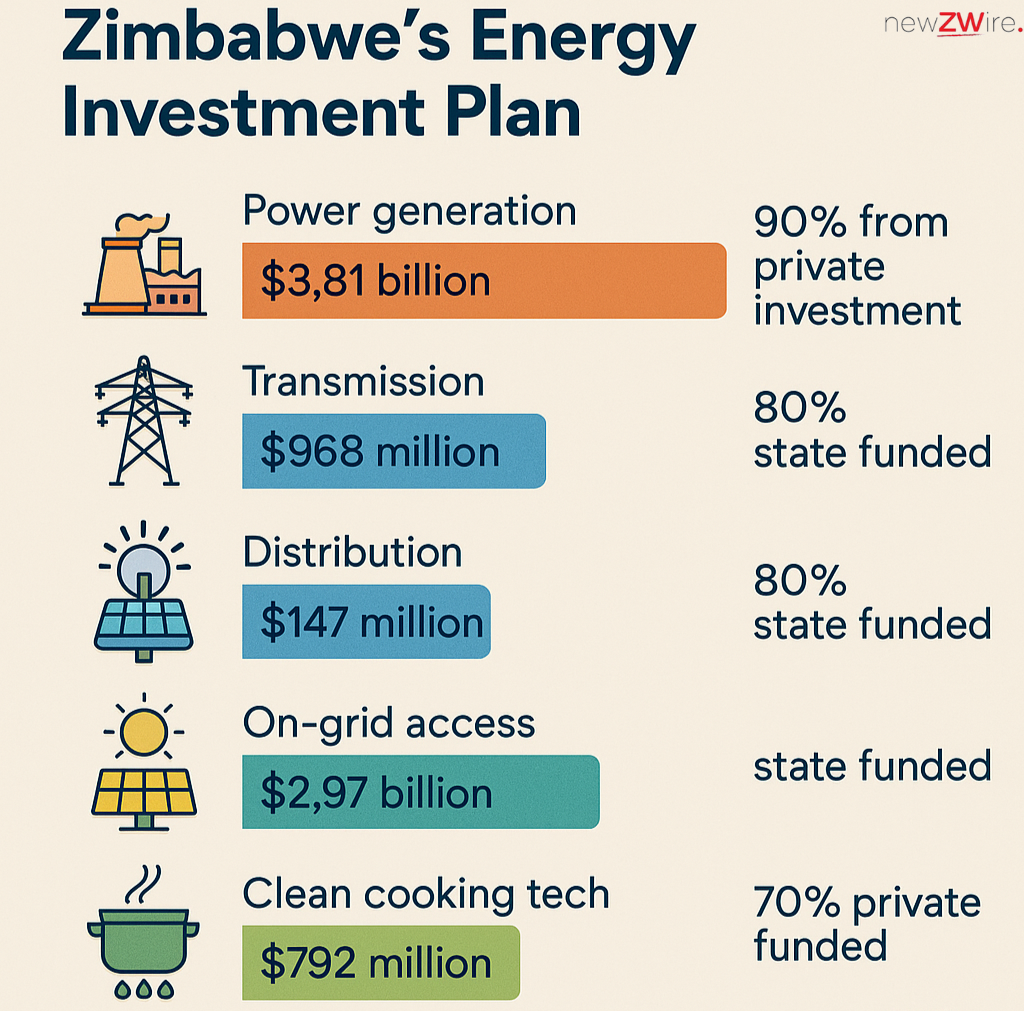
The government plans to launch a competitive Independent Power Producer (IPP) procurement framework by the second quarter of 2026. The pitch is a more liberalised energy market, backed by currency guarantees, cost-reflective tariffs, and easier repatriation of profits.
Renewables: Beyond Kariba
Zimbabwe’s renewable energy mix is currently dominated by hydro, mainly from Kariba. The new strategy aims to diversify. “This will also involve raising non-hydro renewables from 7.8% to 29% of the energy mix and reach 100MW of net-metered capacity by 2025 and an additional 200MW between 2026 to 2030,” the government’s presentation says.
The country also plans to expand its aged transmission and distribution infrastructure, building 1,607km of new transmission lines and introducing smart metering systems. To support this, Zimbabwe has committed to aligning transmission tariffs with regional benchmarks.
Energy pipeline
Zimbabwe has long struggled to attract energy investment due to concerns over tariffs and currency uncertainty. In response, government is now working to “de-risk” the market through the guarantees. So far, US$657 million has been mobilised for private power projects, with another US$391 million in the pipeline. However, US$8.6 billion is still needed for planned projects.
What’s Mission 300?
Mission 300 is a joint initiative by the World Bank and AfDB, launched in January in Tanzania. It aims to connect 300 million people in sub-Saharan Africa to electricity by 2030 by attracting capital from development financiers and private investors.
ALSO READ |
Zimbabwe expects power demand to reach 5000MW by 2030, pushes for more energy projects



