





In the 1990s, I used to work for the British Council in Harare. We had a director called Dr Jim Taylor. He was a chemical engineer by background, and it could partially explain how he worked. A combustible man, he was meticulous in everything he did.
If we were holding a seminar, a training workshop or a conference, his message was clear: “A British Council event is held at British Council standards.” The electricity challenge had started, and fuel could be a pain. The facilities manager knew he had to have a powerful generator on standby to kick in almost immediately when ZESA did its tricks. Everything else had to work flawlessly.
The old school people and standards
Once upon a time, things worked. If you were a civil servant, you knew that once you joined the public service, you were assured of your salary payment by the Salary Services Bureau (SSB). They were efficient in delivering your salary slip with the breakdown and all. You paid your taxes willingly, because you could see where the money was going – schools, higher education facilities, public hospitals, roads, rail…
The tragedy of Zimbabwe lies in the reversal of the standards the country set for itself after 1980. Proper town planners sat in our municipal councils and their advice was taken seriously. It took a certain government minister to begin the violation of our wetlands. A whole PhD with a propensity to steal and appropriate urban land in cahoots with a motormouth businessman who used to park every new car he bought on Samora Machel Avenue, blocking a whole lane. The same minister – a disgruntled former university lecturer with an axe to grind – abused his position at every turn, whether it was imposing some girlfriend of his on a Y2K Committee in 1999 or humiliating academics sitting on the national committees he chaired. In total contrast to this political buffoon were the permanent secretaries, such as Dr Michael Mambo in Higher Education, who strove to bring about coherent policies that matched developments in India and other countries.
The comedy of the national fabric and the funeral parlour decor
Sometimes you have to laugh in order not to cry. Whilst there is a long-serving Committee of Inducing Pain Upon the Populace (IPUP), there is now a vibrant Committee of Simple Ways to Steal Public Funds (SWSPF). Just like with the tender for palm trees and roses as part of the noble, grand and patriotic plan to beautify Harare, the SWSPF Committee sat down and decided the country needed a national fabric. The historians in the Committee did not think that we could go back in history and take inspiration from the Mutapa Empire for cowrie-shell necklaces, bangles, leopard skins, and cloth from the WaSwahili traders. Instead, they were inspired by our amazing multicoloured flag. The result? Some hideous array of colourful-as-an-Amazon-parrot attire ranging from striped jacket that could have been made for some male acapella church choir. The sycophants who had to wear this stuff had to play along – the truth cannot set you free when you are one of the pigs at the feeding trough waiting for Glorious Revolution to hand you your own tender.
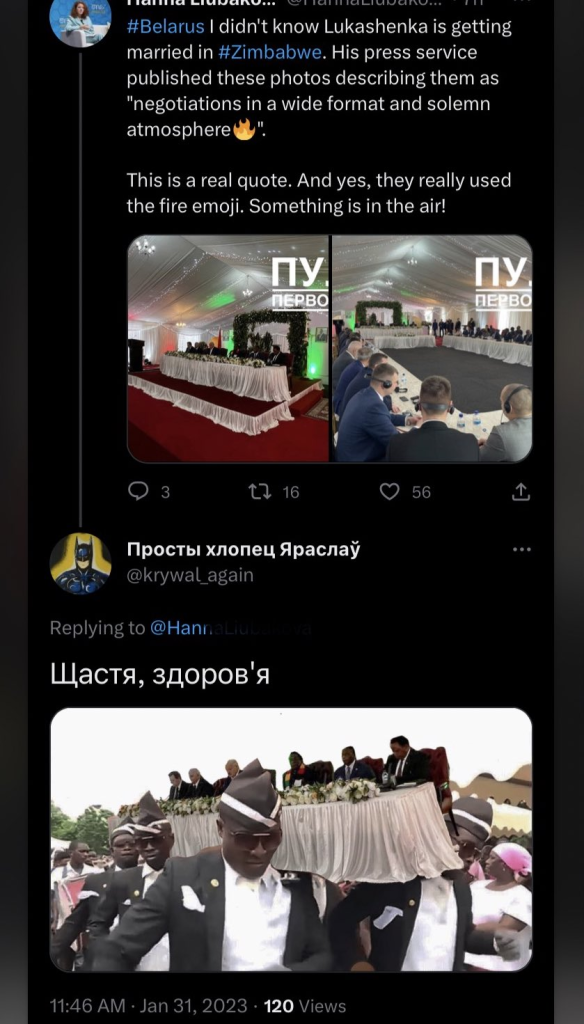
The garish funeral décor that is ubiquitous at national events and press conferences is not going away anytime soon. The contract for recycling the mediocre “curtains” is too sweet to let go. Thieves have no time to learn anything other than more sophisticated methods of burgling the national cashbox.
The fish rots from the head
Piscis primum a capite foetet – the fish stinks first from the head. The rot of mediocrity that the liberation leaders have introduced has successfully spread into every nook and cranny of our society.
A few months back I stayed at the Holiday Inn Samora Machel. Whilst the frontline staff were professional enough, the floor of the lobby was an ashy mess. The furniture in the reception area looked as tired as Kembo Mohadi’s face. The security guard tried to con me when I requested a Holiday Inn taxi. The reservations supervisor quoted me breakfast at US$30 when frontline staff said it was US$20. My belly felt full after that, and I gladly crossed the street to grab some grub.
At the international airport are one bookshop and some craft shops that sell digitally printed books such as David Martin and Phyllis Johnson’s The Struggle for Zimbabwe. How these criminals are allowed to sell pirated copies is a mystery to me. In the House of Books bookshop is a copy of collected short stories of a famous Zimbabwean author now deceased. The publication of the collected stories was clearly coordinated by the family of the dead author. The widow, who has a sterling record in the arts, is not a literary fundi, but she still chose to write the foreword to the collection with typos and hyperbole (Dr Blah Blah – in reference to artists with honorary degrees). The stories are not organised in any meaningful thematic manner and the real atrocity is in updating the names of cities referenced by the author in the 1970s so, for example, Umtali becomes Mutare. But this is now where we are. The sterling editors we had at Mambo Press, College Press, Zimbabwe Publishing House and elsewhere, have been shunted into the sunset. What remains are excellent writers at the mercy of mafikizolo publishers masquerading as editors.
The suckers of energy and creativity
Beyond the daily ritual of mediocrity, Vene and their ilk are masters of sucking your energy. Recently departing from the Harare International Airport (I still refuse to use the name of the Man from Zvimba), I had to go through five checkpoints – having checked in my bags and collected my bags. The first counter had two guys for “Document Check”. From there, you go to another three-person counter where two people (clearly Charlie 10s) handle your passport. You then go to the security checkpoint, where you remove everything except your shirt and trousers. You are now making progress. Just Immigration and Customs left! It is unnecessary but a paranoid regime that creates a system of leeches feeding off patronage does that. Instead of creating an economy that works for all, their watermelon heads are filled with cruelty and thieving tendencies.
We are now waiting for someone to get a tender to water the shrivelling roses and palm trees. When that happens, our dear Mayor might invite us all to see the red, yellow and white roses and exclaim: “The rose is a symbol of love. A metaphor for the unity of a people coming together. We want our people to stop and admire this unique flora and demonstrate to the world that Zimbabwe is LOVE.”
You just have to laugh. Hahaha!
READ MORE From Chris Kabwato
Waiting for Canaan: What kind of leader does Zimbabwe really need?
‘Muchasvinura’: Zimbabwe’s keyboard warriors and the politics of narcissism



