



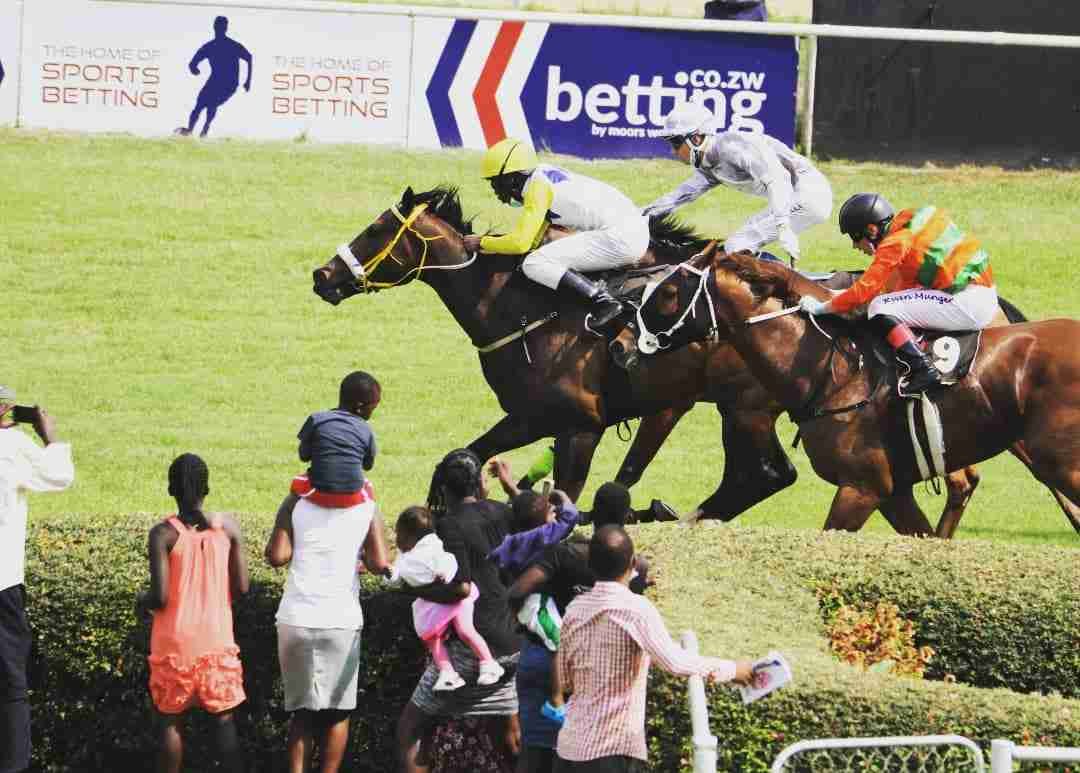
In the 1970s, the men of Dangamvura would assemble nearly every morning at Matongo Shopping Centre to “play horses”. They would dutifully walk into the grocery store, tear off blue, green and brown sheets marked Mashonaland Turf Club and head outside where their friends were huddled together. Each man would be armed with an Eversharp ballpoint pen. Others would have the pen tucked at the top of the ear. A Peter Stuyvesant cigarette and a bottle of Bols Brandy could be doing the rounds.
Each man took their turn to offer their predictions for the horse races happening 265 kilometres away in the capital, Salisbury. They knew the horses so well they could have named the grandparents, uncles and aunts of those horses. They knew the jockeys too and could speak about them as if they lived next door – Willie Carson, Lester Piggott, Tony Murray.
The men especially looked forward to the major horse races that offered big prizes. These included the Castle Tankard at 20,000 Rhodesian dollars and the Benson & Hedges Stakes at 10,000. But there was much more to be won in tote bets and swingers.
For decades the men listened on the radio as the horse racing commentator (Peter Lovemore, Martin Locke) either delivered a result to lift their hearts or to deflate them.
The men also played the lottery and here they claimed to have been made to dream the “winning” numbers by some ancestor or other deceased relative:
“I dreamt of my grandfather cutting a tree with an axe…”
“Ah, 7!”
“Then a snake fell out of the tree…”
“Ah, 8!”
“I saw a hen lay an egg…”
“Ah, zero!”
Betting and financial stress
Our young historians on X who vehemently yearn for Rhodesia would be pleased to know that the men of Dangamvura were largely unemployed or earned a pittance as factory workers. They lived in council-rented two-bedroomed houses where they still needed to lease one bedroom to a “lodger”. Upon retirement they had to vacate the house and retreat to their rural home or wherever the generous white man had designated as home. That could be some “protected village” nicknamed “ku-kipi” or some Tribal Trust Land with tired white soils.
The men had to believe that luck could see them out of financial distress. For many years, my father kept a lotto ticket from the 1970s on which he had correctly predicted the numbers but had gotten the sequence wrong. Apparently, if my old man had gotten everything right, we could have become some wealthy black bourgeoisie in Cde Ian Douglas Smith’s fantastic Rhodesia. We had to wait for one Eddison Zvobgo, who, as Minister of Housing and Local Government, started an excellent home ownership scheme in Dangamvura using unimaginative names like Village 12, Area 13 etc.
Fast forward to 2024
As we closed off 2024 stories abounded on how sports betting was getting out of hand. In one news story, a manager at a fast-food outlet had decided to bet using his employer’s revenue. Apparently, he hoped he would win and return the borrowed principal amount. But it is called betting for a reason. He lost the money and was arrested for theft.
About twenty-two years ago, way before the internet and the mobile phone ruled our lives, I was at Botswana’s Gaborone Sun Hotel. I was struck by the number of elderly women who moved in groups in the hotel casino. They would target a specific slot machine that they figured had been played long enough by others and had not yielded its bounty as yet. The women would take turns slipping their coins into the fruit machine. It was a fascinating scene and, simultaneously, a sad one.
For some reason it reminded me of the excellent short film by the late Senegalese filmmaker, Djibril Diop Mambety, Le Franc. Marigo, a struggling musician who is always in trouble with his landlady, plays the lottery and glues his ticket behind the door to his room. He thinks that is the safest way to preserve his ticket. He wins the lottery but despite all his valiant efforts he cannot remove the ticket in order to claim his prize money. The ending is tragic.
Gambling as adventure
It could be that gambling is a habit that develops due to socialisation. Michael Jordan, the billionaire former basketball player, is a famous gambler, whether on the golf course or playing dominoes with his close friends. Another former basketball player, Charles Barkley, is also a big gambler at Las Vegas casinos. He claims he can spend up to US$250,000 a night when he is out with his buddies. An acquittance of mine who is well-off is obsessed with money. He plays poker occasionally and bets online almost daily. Winning is everything for him.
Handling a crisis
As some African governments wake up to the crisis of gambling addiction, there is the danger of overreaching and treating adults as children. Whether it is the hysteria around the amount of betting advertising on television and online, or the ease with which each one can bet online, it is important that science and data are used in formulating any remedies.
Of course, it would be better to create a society in which people have the dignity of work, housing, education for their children, affordable and excellent health care and public transport. But this is asking for too much from our morally bankrupt leaders.