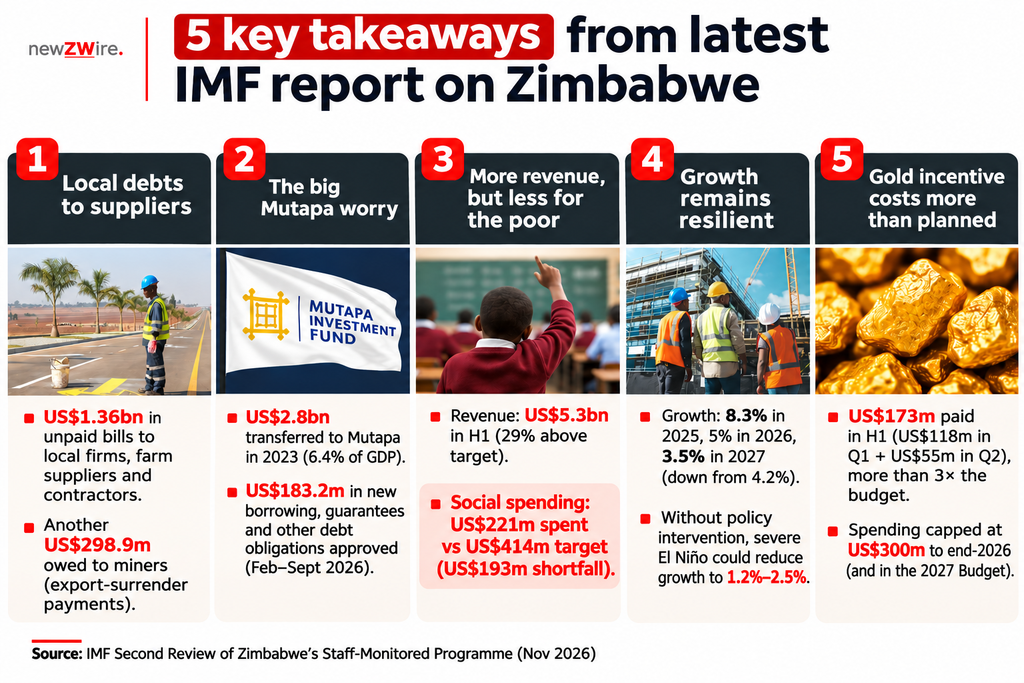









Revenue is booming but spending on the poor is still low. Government owes US$22.7 billion, including US$1.66 billion to service providers and miners. But, in all that, the economic outlook remains strong.
That is the picture from the IMF’s second review of Zimbabwe’s 10-month Staff-Monitored Programme (SMP). The programme comes with no funding, but is meant to help Zimbabwe show progress on economic reforms and work towards clearing its debt arrears.
Here are five takeaways from the latest IMF report.
Government owes local service providers US$1.36 billion
At the end of 2025, Government owed local service providers US$1.36 billion in unpaid bills. The money is owed to local businesses, farm input suppliers and private contractors. Miners were owed another US$298.9 million in unpaid export-surrender payments. Treasury paid some of the miners’ arrears in the second quarter, pushing debt service above target. The Auditor-General is auditing unpaid bills from 2024 and 2025 for roads, dams, water projects, Finance Ministry spending and the Input Support Scheme. The reports are due this month and will guide what the Government pays next. Some road and dam contractors have already been paid based on certificates for completed work.
The big Mutapa worry
The IMF is concerned about the amount of debt and financial risk linked to the Mutapa Investment Fund. A bond-financed loan to Mutapa is one of the main reasons Zimbabwe’s debt repayments are so high. In 2023, Treasury transferred US$2.8 billion to Mutapa, equal to 6.4% of GDP. The money was recorded partly as a loan to buy equity and partly as a transfer to the RBZ to settle some old US dollar commitments.
Between February 6 and September 16, 2026, Treasury approved US$183.2 million in new borrowing by Mutapa and its subsidiaries. The report does not say what the money will be used for. Under the SMP, Mutapa and its subsidiaries must disclose their borrowings. Loans above set limits will now need ministerial approval and Parliament must be notified. Treasury will also include a section in the national budget showing the financial risks posed by state firms.
Collecting more money, but not spending enough on the poor
Government is raising record taxes. The IMF has raised its forecast for Government revenue in 2026 to US$11.6 billion, from US$8.4 billion in 2025. That is an increase of almost 40%. In the first half of this year, collections reached US$5.3 billion, 29% above target. Income tax, company tax and VAT were the main drivers. The government is now expected to end 2026 with a cash surplus of US$1.4 billion.
But this money is not being spent where it’s needed most. Social spending is lacking. Government spent US$221 million on social spending in the first half, against a target of US$414 million. BEAM, which pays school fees for disadvantaged children, used just US$3.7 million of its US$182 million allocation after payments were stopped pending an audit. Health spending was US$42 million against a target of US$90 million. The full-year social spending forecast has been cut from US$755 million to US$345 million.
Contrast that with the gold incentive scheme, which received about US$173 million from Treasury in the first six months. The IMF says the social spending shortfall isn’t because there’s no money. It’s a case of implementation bottlenecks “rather than a lack of fiscal resources”.
Growth strong, but will get slower
Zimbabwe’s economy grew by 8.3% in 2025. The IMF expects growth of 5% this year, although it slowed to 3.1% in the second quarter, partly because of weaker mining activity. The Fund has cut its 2027 growth forecast from 4.2% to 3.5%, mainly because of an expected El Niño drought. Government estimates that a severe drought could reduce growth to between 1.2% and 2.5% if no action is taken. Inflation is also expected to rise to about 6% by the end of 2027 as food prices increase.
Gold scheme costing more than planned
Since 2021, Treasury has paid bonuses in US dollars on gold sold to Fidelity Gold Refinery. The rates are 5%, 7% or 9%, depending on how much gold is sold each month. Government says the scheme is meant to discourage smuggling.
But record gold production and high prices have pushed the bill to more than three times the budget allocation. Treasury paid US$118 million in the first quarter and another US$55 million in the second. The IMF says there is no spending limit on the scheme, making it difficult to control the cost. It also argues that the volume-based rates encourage sellers to combine their gold through large buying agents. This means the bonuses end up going to middlemen instead of small-scale miners.
The IMF wants Government to introduce one lower rate within a fixed budget, publish the names of those receiving payments and allow more competition among gold buyers. Government has agreed to cap spending at US$300 million through to the end of 2026 and keep a spending limit in the 2027 Budget. The budget will also propose wider changes to the gold market under the 2025 Gold Trade Act.