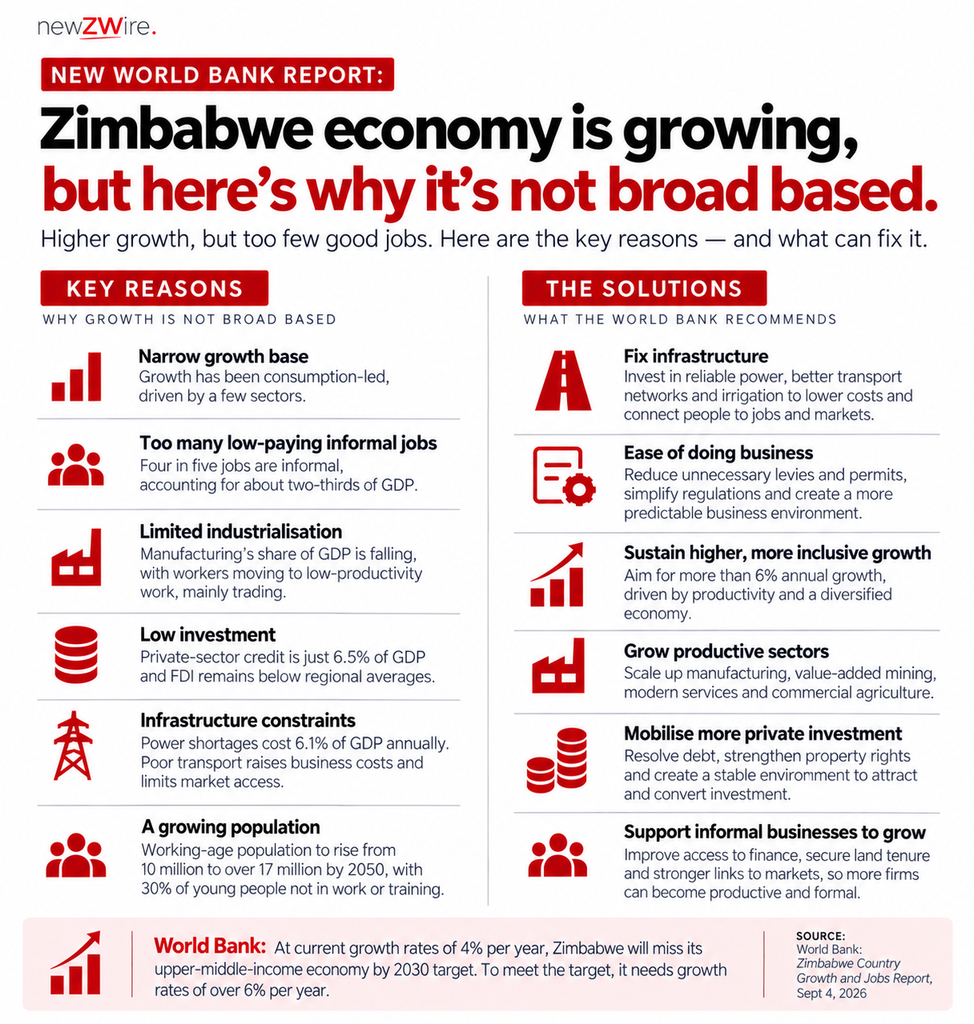






Zimbabwe’s economy has returned to growth after years of crisis, according to a new World Bank report. The country averaged almost 6% growth between 2021 and 2025, reaching 8.3% in 2025.
But, according to the World Bank’s Zimbabwe Country Growth and Jobs Report, released Friday, these strong growth figures are yet to “translate into broad-based improvements in living standards”.
The economy is not growing fast enough or broadly enough to deliver the jobs and incomes Zimbabwe needs. Zimbabwe has a window to turn current relative stability into a more productive economy, but that window may be closing fast without major reforms that change how the whole economy is structured, the World Bank says.
Here are some of the key messages from the report.
Economy is growing, but not fast enough
Without key reforms, the World Bank expects growth to average only about 4% a year to 2030. That is below the more than 6% annual growth needed to meet the government’s target of becoming an upper-middle-income economy by 2030. On the current path, if government keeps it “business-as-usual”, that target would only be reached around 2036.
An informal economy’s low productivity
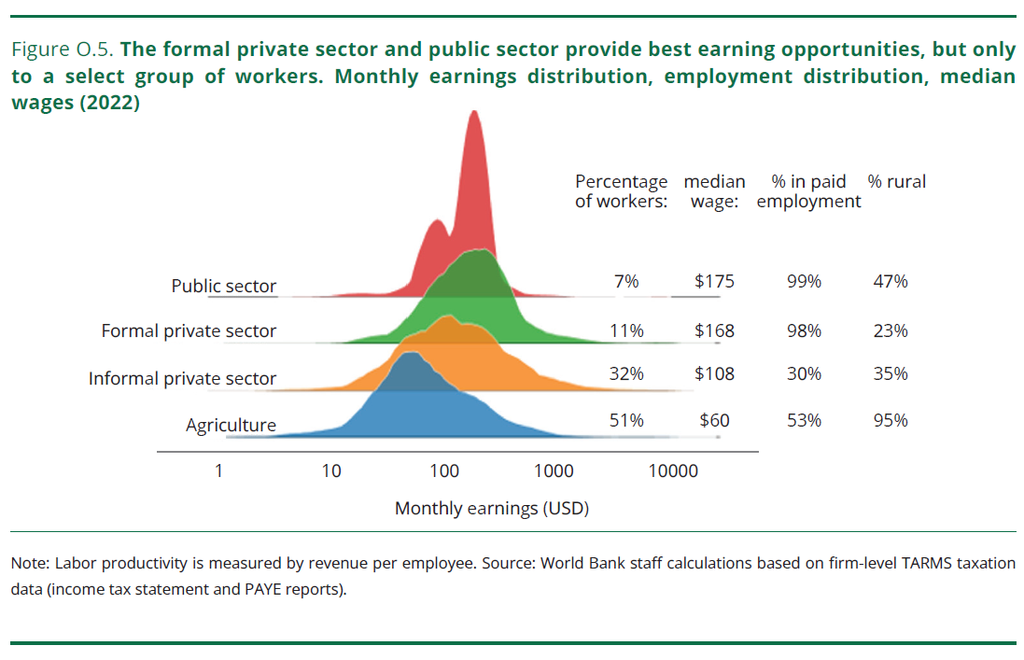
The report says growth has been “predominantly consumption-led and driven by a narrow sectoral base”. Agriculture and mining each account for more than 10% of total value added, but the rest of the economy is trapped in “low-productivity retail and informal services rather than higher-value industries” – trading. Four in five jobs are informal, and the informal economy accounts for about two-thirds of GDP. Median earnings are $130 per month, and nearly half the population lives below the international poverty line. Median monthly earnings were about US$60 in agriculture, US$108 in the informal private sector and US$168 in the formal private sector in 2022.
Manufacturing: the missing link
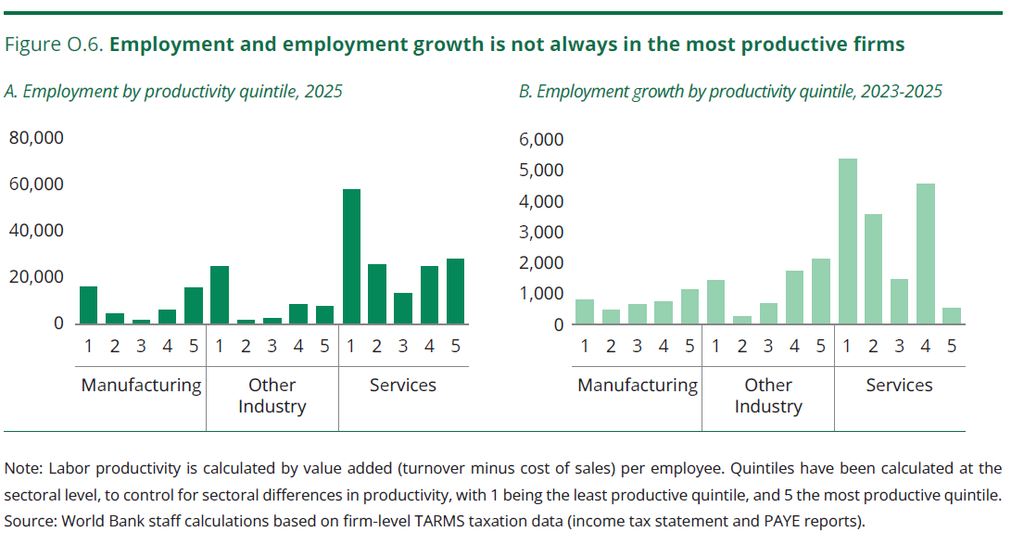
Agriculture and mining remain key to the economy, but a missing middle is manufacturing. The World Bank says workers leaving agriculture are largely moving into informal trade and services rather than manufacturing, “one of the clearest pathways to productive formal employment.” Zimbabwe is moving from farms into shops and informal businesses, when it needs more workers moving into factories, mines, agro-processing, logistics, tourism and higher-value services.
Mining can drive growth, but it cannot do the whole job
Mining is one of Zimbabwe’s biggest advantages. The country has major deposits of PGMs, lithium, gold and diamonds. But mining is capital intensive. This means that higher mining output does not automatically mean large numbers of jobs. The bigger opportunity is to get more value from what Zimbabwe already mines. The World Bank says mining needs “not just increased extraction but greater domestic value addition.” That means more processing and downstream industries. The same applies to agriculture.
Zimbabwe has a jobs problem
The working-age population is about 10 million today and is projected to exceed 17 million by 2050. Zimbabwe has a relatively educated workforce, but too few productive businesses to employ it. The public sector absorbs about 40% of tertiary-educated workers, while around 30% of young people are neither working nor in education or training. Zimbabwe needs more productive firms creating jobs for the people it already has.
Investment is too low
Zimbabwe has natural resources and human capital, but too little private capital is being deployed. Private-sector credit is only 6.5% of GDP, compared with 22% in Côte d’Ivoire, 32% in Kenya and 58% in South Africa.
FDI is too low. Zimbabwe’s inward FDI was about 18% of GDP in 2024, against 36% for sub-Saharan Africa and 39% for SADC. Annual FDI inflows rose from about US$150 million in 2020 to US$600 million in 2023, although they fell to US$460 million in 2024. Zimbabwe has “an educated workforce, abundant natural resources, and strong potential for regional integration”, but macroeconomic instability, infrastructure gaps, regulation and low private investment have prevented the country from converting those advantages into better living standards.
Infrastructure makes everything more expensive
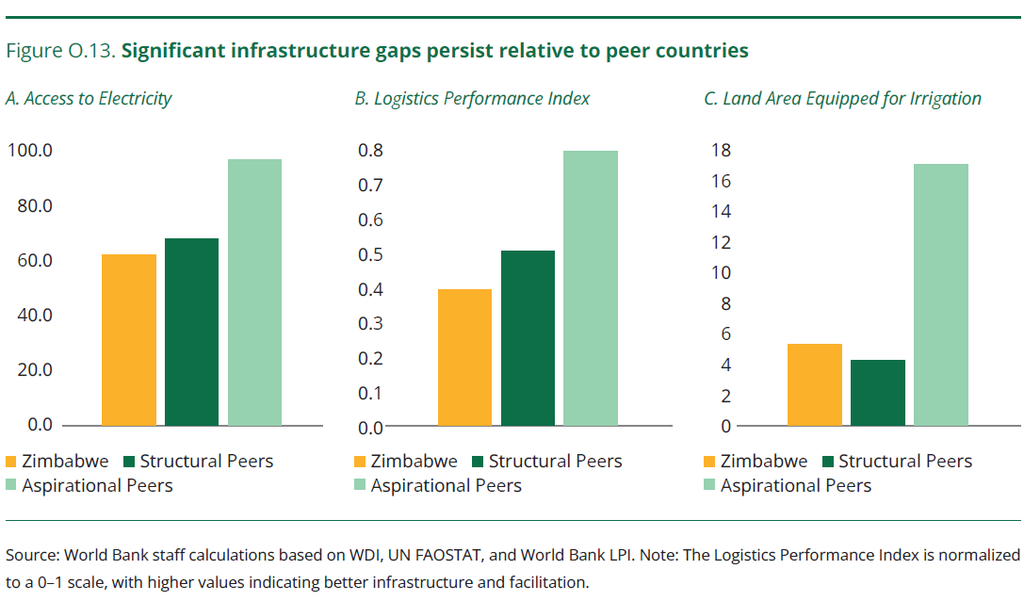
Power shortages cost Zimbabwe 6.1% of GDP each year. Agriculture faces a similar problem. Only around 5% of Zimbabwe’s 2 million hectares of arable land is irrigated, leaving farmers exposed to drought. Bad roads and rail make goods more expensive and keep investors away, the report says.
What must be done?
The report boils it down to three things: invest in infrastructure, especially power, roads and rail. The Bank also says Zimbabwe make it easier to operate and expand business. This can be done by cutting the number of permits and licenses companies need, lowering the tax burden on hiring workers, speeding up customs at borders to reduce trade costs, simplifying registration for small businesses. Zimbabwe should mobilise more private capital, secure property rights, especially land titles that banks accept as collateral, Deepen banking system.
The World Bank estimates that its reform package could make real GDP 26.9% higher than the baseline by 2040 and generate nearly 2.7 million additional and better-paid jobs. If Zimbabwe fully implements these reforms, GDP could grow 10.7% faster by 2030, above the 4% baseline.
According to the World Bank, the stability is real, but fragile. It has benefited from high commodity prices and strong tobacco harvests, while Zimbabwe’s debt distress and arrears continue to restrict access to concessional finance. For more sustainable growth, the World Bank says Zimbabwe needs growth that changes the structure of the economy.