


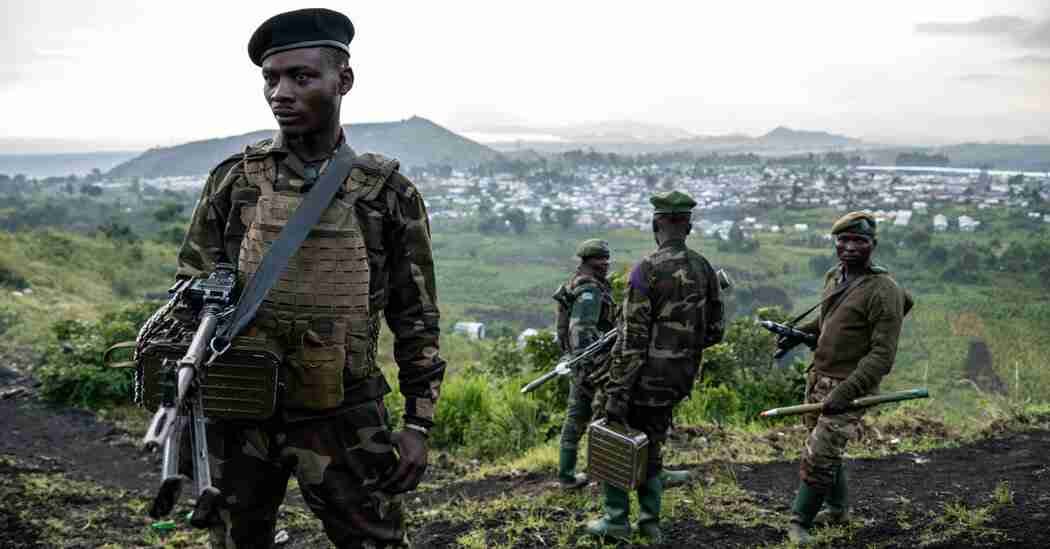
The conflict in the Democratic Republic of the Congo (DRC) is once again in the global spotlight after Rwanda-backed M23 rebels claimed control of the eastern city of Goma.
Heavy fighting between the Congolese armed forces (FARDC) and the rebels has killed dozens and displaced thousands of people from the city – home to some two million people and about half a million displaced people seeking refuge there.
The latest round of fighting has claimed the lives of over a dozen soldiers from the SADC peacekeeping mission – from South Africa, Tanzania. This has prompted SADC chair President Emmerson Mnangagwa to host an emergency summit in Harare. South Africa’s President Cyril Ramaphosa has accused Rwanda of escalating the crisis. Rwandan leader Paul Kagame has responded with a sharp rebuke, saying: “If South Africa prefers confrontation, Rwanda will deal with the matter in that context any day.”
Racked by conflict for more than 30 years, the DRC’s insecurity is caused by complex and deep-seated factors, as well as a multitude of actors. Apart from the M23, numerous other armed groups, Congolese and foreign forces are battling for control, mostly in the eastern part of the country.
Approximately six million people have been killed since 1996 and nearly as many remain internally displaced in the eastern DRC.
Here’s a guide to the decades-old conflict in the country:
How did the 1994 Rwandan genocide affect the DRC?
- The DRC crisis originally began as a result of a series of postcolonial battles for power after independence from Belgium in 1960, which culminated in the assassination of popular leader Patrice Lumumba and the three-decade military rule under dictator Mobutu Sese Seko.
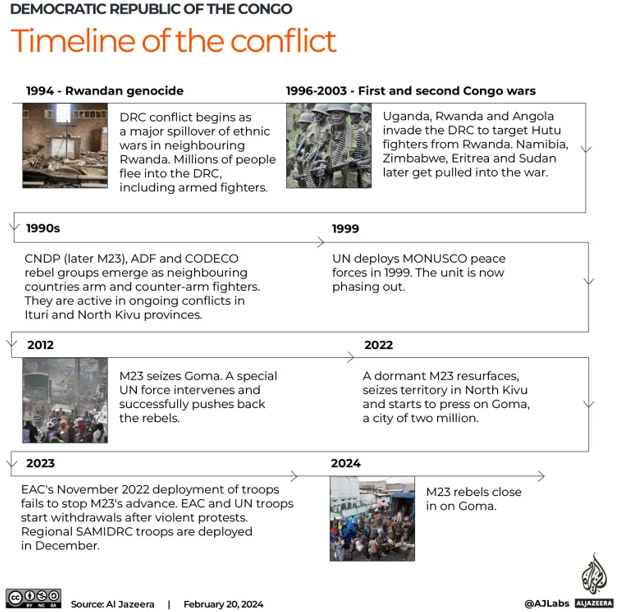
- In the early 1990s, the DRC saw a spillover of civil war and subsequent genocide in neighbouring Rwanda. In October 1990, a civil war broke out after the Rwandan Patriotic Front (RPF), a Tutsi rebel group led by current Rwandan President Paul Kagame, invaded the country from its Ugandan base. In April 1994, hardline Hutu militias attacked Tutsis and moderate Hutus, killing 800,000 to a million people over 100 days in what is now known as the Rwandan genocide. Hutus form some 80% of Rwanda’s population.
- Kagame’s RPF seized Kigali on July 4 as Hutu genocidaires, troops, and former regime leaders fled to the DRC. An estimated two million Hutu civilians fearing revenge and reprisal attacks also poured into the country.
What led to the First Congo War of 1996-97?
- Tensions rose between local Congolese tribes, Rwandan emigrants from the colonial and pre-1960 independence periods, and those who fled the 1994 war. Often, local tribes battled Tutsis, but conflicts also existed with the Hutus, as locals feared they would be outnumbered. Earlier emigrants had rights to Congolese citizenship, but later emigrants were regarded as refugees and many were housed in camps.
- Hutu militias who fled Kagame’s rule to refugee camps in the eastern DRC began to regroup to restore a Hutu government in Kigali. They launched attacks on Rwanda and also killed Tutsis inside the Congo. In response, Rwanda started to arm Tutsi militias inside the DRC.
- Across the DRC, many Congolese were resentful of Mobutu’s rule. Rebel groups seeking to overthrow him emerged, including the Alliance of Democratic Forces for the Liberation of Congo (AFDL), led by Laurent-Desire Kabila.
- Rwanda, which accused Mobutu of harbouring Hutu perpetrators of genocide, armed the rebels and sent in Rwandan troops in 1996.
- On October 24, 1996, the Tutsi-dominated AFDL in Kivu and troops of the Rwandan armylaunched offensives in eastern DRC, sparking the First Congo War. Uganda, Eritrea, Angola, and Burundi – all Rwandan allies – joined the war.
- The AFDL seized power on May 17, 1997, ending the fighting, and Kabila became president of the DRC. But the Rwandan troops allegedly massacred Hutu populations, forcefully repatriated Tutsis, and took control of lucrative diamond and coltan mines in the resource-rich eastern region bordering Rwanda.
What caused the 1998-2003 Second Congo War?
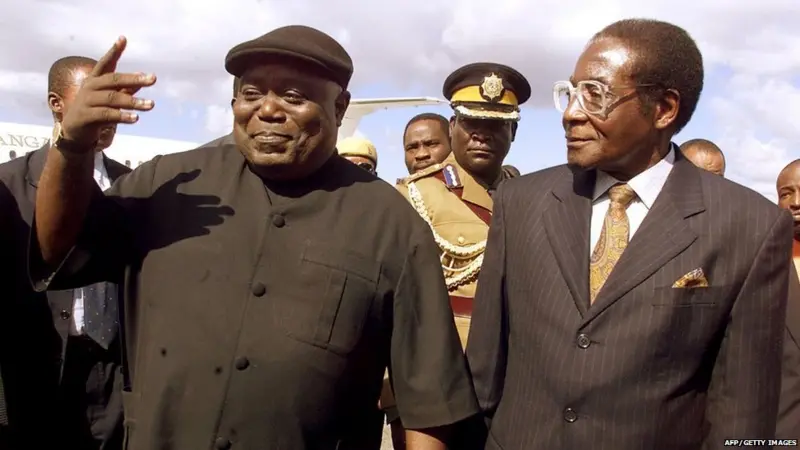
- After his climb to power, Kabila fell out with Kagame and started to force out Rwandan and other foreign troops still in the DRC. This alarmed ethnic Tutsis living in the DRC and reignited tensions with local groups.
- In response, Rwanda backed a new rebel group, the Rally for Congolese Democracy (RCD), which launched a revolt in August 1998 and started the Second Congo War. A parallel group, the Movement for the Liberation of Congo (MLC), formed to fight alongside the RCD, also seeking to overthrow Kabila.
- The DRC and rights groups claim MLC was backed by Uganda, which had also fallen out with Kabila. Jean-Pierre Bemba led the armed group that has now morphed into an opposition political party.
- Kabila’s government armed Hutu refugees in the east to fight back against Rwanda and RCD. Government officials publicly incited Congolese people to attack Tutsis, leading to several public lynchings. The South African Development Community (SADC), of which the DRC is a member, deployed troops from Zimbabwe, Namibia, and Angola to fight RCD and Rwandan troops.
- In 1999, the DRC, Uganda and Rwanda signed a set of ceasefire agreements, including the Lusaka Ceasefire Agreement (1999) and the Luanda Agreement (2002), which were to see all sides stop military operations. The agreements also triggered the UN to deploy MONUSCO (UN Organisation Stabilisation Mission in the DRC) troops to monitor the peace process.
- However, fighting persisted in many areas, like gold-rich Ituri, where ethnic tensions, worsened by the war, erupted into a continuing conflict.
How did M23 and other major rebel groups emerge?
M23: Operating in the North Kivu province, the group takes its name from the March 23 Agreement of 2009 when the DRC government, under President Joseph Kabila — son of Laurent-Desire Kabila — signed a ceasefire treaty with the Tutsi-majority National Congress for the Defence of the People (CNDP), one of the numerous groups of fighters active since the Second Congo War. In the agreement, the CNDP was meant to become a political party and its fighters were to integrate into the Congolese military, FARDC.
However, on April 4, 2012, 300 CNDP soldiers revolted, complaining of poor treatment in the army. They formed the M23, claiming to be fighting for Tutsis’ rights in the DRC. In late 2012, M23 launched an offensive, seizing Goma and several other towns. A special UN force along with FARDC pushed the rebels back into the eastern hills on the border with Rwanda in 2013.
M23 resurfaced in 2022 with violent attacks and has seized at least four towns in North Kivu. The group briefly withdrew from occupied towns in January 2023 as part of the Nairobi Peace Process, but the ceasefire fell apart in October. Fighting between M23 rebels and FARDC erupted again at the beginning of last year.
ADF: Originally from Uganda, the Allied Democratic Forces (ADF) also operates in the eastern DRC, in the regions bordering Uganda. The group initially claimed to be fighting for an Islamic state in Uganda, where Muslims make up a minority of between 15 and 35 percent. It is not clear what boundaries the reclusive ADF wants to claim, but the group first settled in Buseruka, western Uganda, before it was pushed back into the DRC. But it has recruited along secular lines over the years. Formed in 1996, during the First Congo War, it used a weak DRC as its base to launch attacks into Uganda. Ugandan troops used their presence in the DRC during the two wars to attack ADF fighters. The group went dormant in 2001 and resurfaced in 2013. It is now reportedly linked to the ISIL (ISIS) armed group.
CODECO: The Cooperative for Development of the Congo (CODECO) was formed in 1999 during the Second Congo War. It operates in eastern Ituri. It was initially an agricultural cooperative, but it started to advocate for the Lendu ethnic group, who believed they were unfairly dominated by the rival Hema ethnic group. After a period of dormancy, CODECO launched offensives in 2017 and has continued to attack local civilians and Congolese forces. In February 2024, CODECO ambushed civilians, killing 15 people believed to be Hema in a likely continuation of the rivalry. The group has also targeted gold mines in recent weeks.
Other actors: Also operating are several pro-government militias and “Mai Mai” vigilante groups jointly called the Wazalendos, fighting with the Congolese army. Some 40,000 Wazalendos have undergone military training since 2022, when current President Felix Tshisekedi called for young Congolese to help defend the country.
There is also the Democratic Forces for the Liberation of Rwanda (FDLR), an ethnic Hutu group active since the final years of the Second Congo War and backed by the Congolese army, according to a UN Experts Group report. Some of its leaders took part in the 1994 Rwandan genocide.
What’s the legacy of UN and regional peacekeepers?
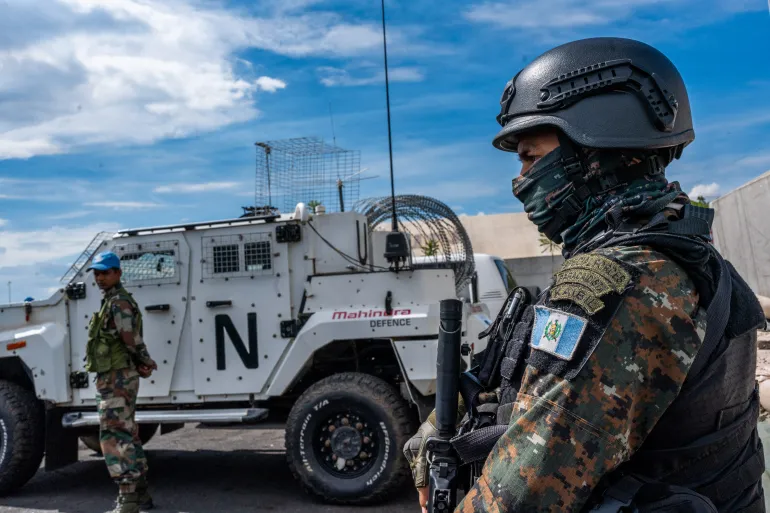
- MONUSCO is one of the most expensive and extensive UN missions in history, comprising 10,183 soldiers and about 3,000 additional civilian personnel. Its 2022 budget was about $1.1bn.
- But MONUSCO is deeply unpopular in the DRC, seen as having little to no impact. In 2022, violent protests erupted calling for its exit following renewed M23 attacks.
- In December 2023, the UNSC voted to pull out MONUSCO a year earlier than planned, despite fears the troops’ absence would create security vacuums and more instability.
- Similar issues have plagued regional military missions. In 2022, the East African Community, which the DRC is part of, deployed troops as part of the EAC Regional Force (EACRF). The force, led by Kenya, was meant to facilitate the Nairobi Process, a 2022 ceasefire agreement, by ensuring the withdrawal of multiple rebel groups from occupied territories in the eastern DRC, including M23. But within months, the Tshisekedi government accused the contingent of colluding with rebels and not launching offensives. The presence of Rwandan troops in the force also raised alarm in Kinshasa. Barely a year later, the troops left.
What’s the effect of mining on the conflict?
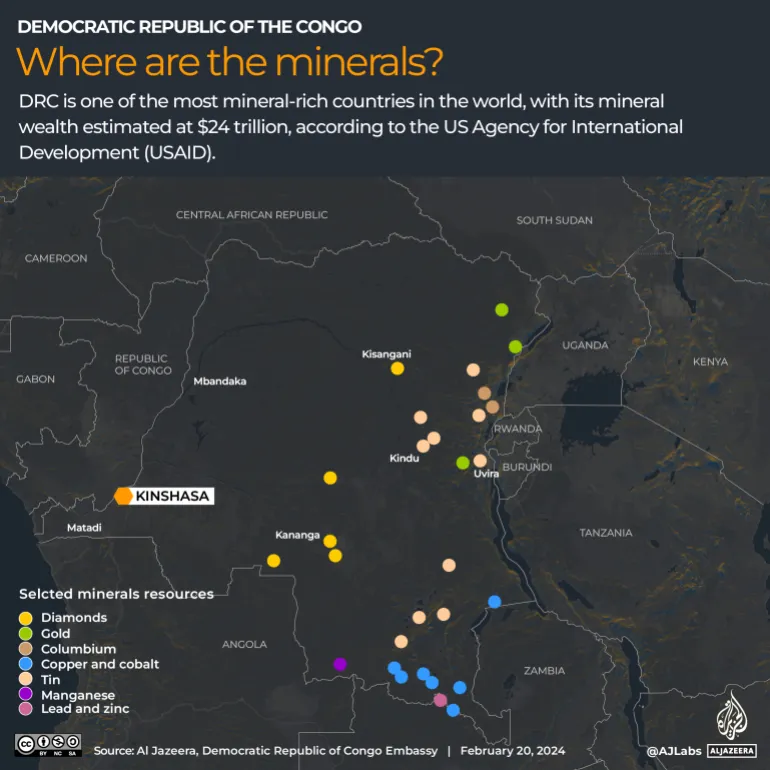
- The DRC is home to some of the world’s largest reserves of metals and rare earth minerals, like cobalt, considered essential in the lithium-ion batteries that power electric vehicles (EVs). As much as 70% of the world’s cobalt supply comes from the DRC. Coltan, used in gadgets like PlayStations and smartphones, is also plentiful in the eastern DRC.
- During the civil wars, Rwandan and Ugandan troops looted DRC’s minerals, although only Kampala was forced by the International Court of Justice (ICJ) to pay reparations to the DRC for the economic damage caused.
How is the conflict affecting Kigali-Kinshasa relationships?
- The DRC has severed diplomatic ties with Rwanda as the fighting between the Congolese army and the M23 armed group intensifies.
- Tensions have escalated between presidents Tshisekedi and Kagame since the M23 resurgence in 2022. On the campaign trail for re-election in December 2023, Tshisekedi called Kagame “Hitler” and threatened all-out war.
- Kinshasa, as well as the UN and the US, have accused Rwanda of supporting M23. Kigali in turn blames Kinshasa for arming the FDLR, one of the Hutu militias that sprung from the civil wars and that is attacking Rwanda. Anti-Rwanda protests erupted in Goma in February 2024, with demonstrators burning Rwandan flags, as well as those of Western countries seen to be backing Kigali.
- The UN has warned of the risk of a broader regional war.
Al Jazeera (additional: newZWire)



