



The government has released its 2023/2024 crop assessment report, offering a look into the state of agriculture.
The headline news is positive: Zimbabwe is set to harvest significantly more maize this season compared to last year, when drought slashed output by over 70%. However, the report also shows a critical problem —productivity remains low across much of the country’s farming sector.
A rebound is great news, but total figures of total production don’t tell the full story. Yield—tonnes produced per hectare—is a better measure of efficiency. The country’s deeper challenge is one of efficiency, not just volume.
Key findings
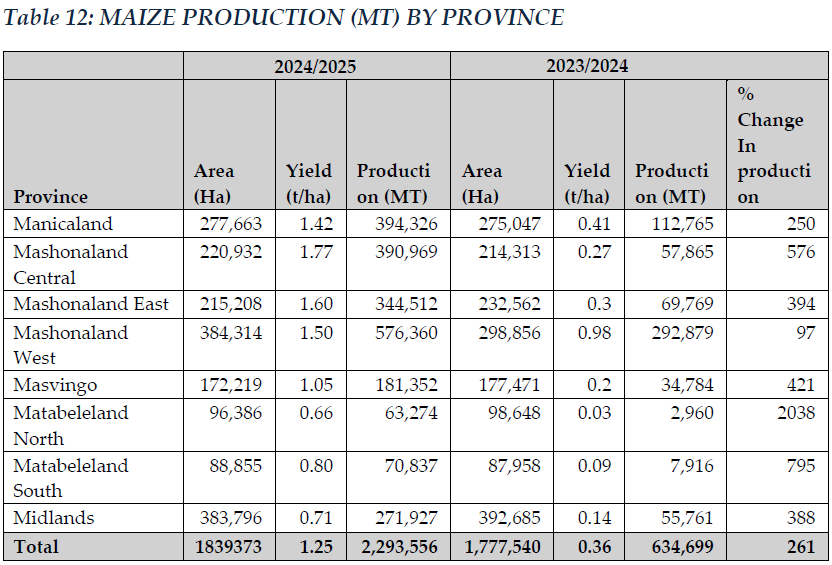
The Ministry of Agriculture projects a maize harvest of 2,293,556 metric tonnes, 261% more than last season. This output comes from 1,839,373 hectares, which is just 6.4% more land than was planted last year.
This means the average national maize yield stands at just 1.25 tonnes per hectare. Yield is a measure of how productive a farmer is. The maize yield figure signals poor productivity, despite better rainfall.
Who’s growing what
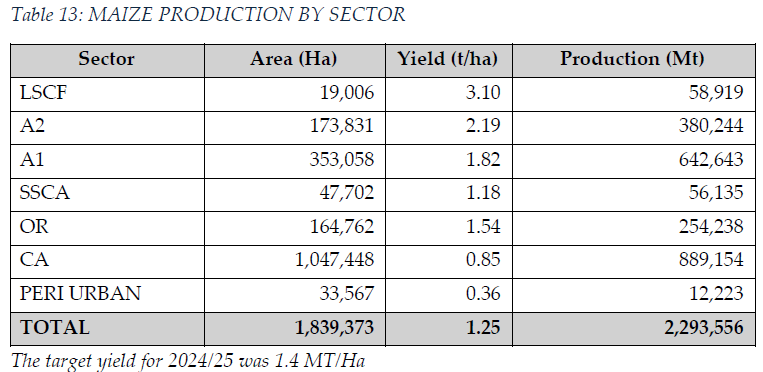
Communal farmers, who work 57% of the maize land, are producing just 39% of the total output. Their average yield is about 800kg per hectare. A1 farmers occupy 19% of the maize area and contribute 28% of the output. Pfumvudza/Intwasa plots yield 1.4 tonnes per hectare, up from 0.3t/ha last season, but still below the 2.4t/ha achieved in 2022/23.
The report says: “There is a need to further evaluate the optimum plant population for traditional grains under Pfumvudza, as the current plant population under Pfumvudza specifications is still low, hence a lower yield.”
Even commercial farmers aren’t doing any better. Large-scale commercial farmers are averaging 3.1 tonnes per hectare, A2 farmers are producing 2t/ha, and A1 farmers remain just over 1t/ha.
How do we compare?
In the last season, South Africa produced 14.7 million tonnes of maize from 2.6 million hectares, translating to 5.6t/ha. South Africa uses genetically enhanced seed, but even peers that don’t have better yields than Zimbabwe. In Zambia, where small scale farmers produce 90% of the maize, yields are between 1.5 tonnes and 2 tonnes per hectare, and farmers get fertiliser subsidies. Yields are 1.7t/ha in Malawi.
What’s our problem?
Farmers face expensive inputs, especially fertiliser, which accounts for 30–40% of production costs. By some estimates, consumption of fertiliser per hectare is four times higher in Zambia than in Zimbabwe. Poor farming practices and limited extension services are also hurting yields.



