




Cabinet has announced a major shift in land tenure, doing away with the leases and offer letters that have been used since land reform began 24 years ago. Farmers on resettled land are to get new tenure documents, according to a Cabinet statement. This, the government says, is meant to “unlock land value”.
What is the government proposing? What has changed, and why? And what are some of the questions that still need answering? The proposed legislation is yet to be made public in full, but here is what we need to know so far about the land tenure changes.
Why the change?
Zimbabwe began the fast-track land reform in 2000. By 2010, over 200,000 households had been resettled, according to government data. Many were on A2 commercial land. Banks refuse to lend to farmers based on offer letters or 99-year leases. This is because a bank cannot sell that land if a borrower fails to pay back a loan. Farmers cannot get “affordable, appropriately structured and adequate finance for sustainable commercial agriculture”, Cabinet says. Because they cannot borrow, farmers “are not sufficiently motivated” to invest in long term infrastructure on the farms. This move, government believes, will now farmers to use land as bank collateral. Banks have long lobbied for transferable title; the bankers say they will assess the proposed tenure system once details are made public.
The tenure changes do not apply to communal land under chiefs, where “sabhuku deals” for land are common.
Farmers aren’t paying back the money
Cabinet says farmers have been bad debtors under government funding programmes. With no tenure, farmers felt no “obligation to pay back loans advanced.” This has added to government debt.
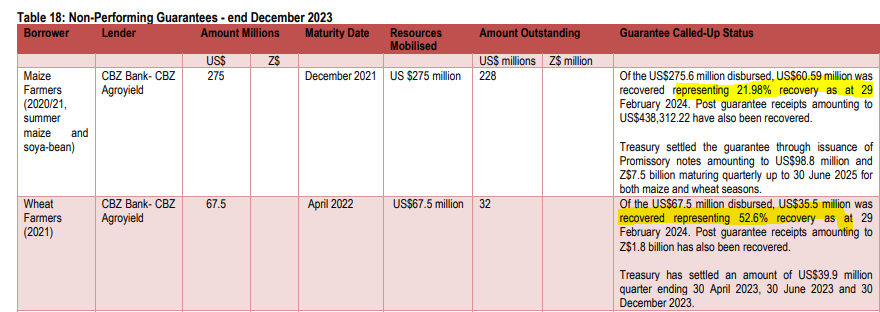
Just how bad is this default? Treasury’s debt report gives some insight. Government guarantees bank loans to farmers; when a farmer doesn’t pay back a bank loan under a government programme, the government picks up the bill. In the 2020/21 season, CBZ loaned out US$275 million to maize farmers. By February this year, only 22% of these loans – just US$60 million – had been paid back. The taxpayer has to pay up. By giving farmers new tenure, the government is looking to wean them off such credit.
What is new?
Currently, resettled farmers occupy land based on offer letters or 99-year leases. These now fall away. No such permits will be issued. Instead, landholders get “a bankable, registrable and transferrable more secure document of tenure”. It is telling that Cabinet did not use the term “title deeds”, leaving the form of tenure uncertain.
Resettled farmers are also not allowed to sell their land. They will now be able to do so. But there’s a catch; they can only sell to “indigenous Zimbabweans”. Why? Government fears that white former farmers will buy back the land on the cheap, according to Reneth Mano, an agricultural economist. In some parts of the world, he says, non-citizens cannot buy farmland. “Zimbabwe is following suit to make sure that we don’t export land and lose the gains realised from land reform,” says Mano.
But, some key questions
The proposed legislation is not yet out, so it’s hard to discuss in detail how exactly it would be implemented. However, based on the Cabinet statement, the new law would need to answer many legal questions.
Who is “an indigenous Zimbabwean”
First, the Constitution vests all agriculture land in the State. The proposed law would also have to define what an “indigenous Zimbabwean” is. The Constitution does not define the term. However, previous legislation, such as the Indigenisation and Empowerment Act, defined an Indigenous Zimbabwean as: “Any person who before the 18th of April 1980 was disadvantaged by unfair discrimination on the grounds of his or her race, and any descendant of such person.”
If that definition is used, only black Zimbabweans would buy and sell agricultural land. Zimbabwean-born white citizens would not. This would violate the Constitution. Section 289 says “every Zimbabwean citizen has a right to acquire, hold, occupy, use, transfer, hypothecate, lease or dispose of agricultural land regardless of his or her race or colour”.
What about companies?
The law would also have to clarify if companies can hold land, and then look at the ownership of such firms to ensure compliance. The Constitution allows people to buy and sell property “either individually or in association with others”.
What about that compensation deal?
The Cabinet statement did not include details on the US$3.5 billion deal to compensate white farmers for developments on the land (and not the land itself). Questions will be asked on whether beneficiaries, or buyers, should pay a levy towards settling this debt.
What about ‘rule of law’ and politics?
In Zimbabwe, the problem has not all been about the type of title – but about security of tenure. Often, landholders are displaced over political differences, with no legal recourse. This has undermined bank confidence, more than the mode of title. Does this new tenure system end that impunity, which has been used by the ruling elite to keep critics and its own supporters in check?
The mis-deeds office?
Can the Deeds Office, the subject of high-profile fraud cases recently and overseeing a chaotic land registry, be trusted to handle the new land system?
Multiple farm owners?
The proposed law would also have to deal with people holding on to multiple farms, an unfulfilled promise of multiple land audits; will there be a limit on how much land one can sell?
How do we compare?
In the region, Zambia does not have freehold (private title). Land is owned by the state and occupied by either customary title or leases. President Hakainde Hichilema has previously said this must change to give locals full title. Land ownership in Tanzania, one of the region’s strongest maize producers, is through lease. Foreigners cannot own land, and can only occupy land for investment. There is no private land ownership in Mozambique. Botswana has private title – but this covers just 3% of its land.
ALSO READ |
Zimbabwe has signed a US$3.5bn compensation deal with white farmers. Here’s what you need to know



