
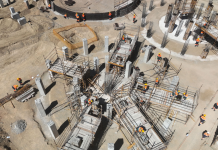



Zimbabwe and Zambia have completed the Kariba Dam wall rehabilitation project, described by the main funder as “one of the most impressive European Union-funded engineering projects in Africa”.
The project involved reshaping the plunge pool at the bottom of the dam wall to protect it from erosion.
Over the years, water falling from the dam’s sluice gates eroded the rock floor at the foot of the dam, creating an 80m-deep pool. Engineers feared that this would one day threaten the dam’s foundations, and they came up with a solution – reshape the pool.
“There was a need to reshape the plunge pool to create a new stepped profile aimed at decreasing the amount of swirling, improving energy dissipation and guiding the spilling water away from the dam foundation,” explains Energy Minister Edgar Moyo.
Had this not been done, there was a risk that Kariba would one day collapse. If this happened, up to 500,000 people would die, three million more would be affected, and the economic impact would be at least US$20 billion.
The EU then provided 113 million euros for the project, under its Global Gateway strategy to promote green energy. Further funding came from AfDB (US$75 million, World Bank (US$75 million) and the Swedish government (US$25 million) for technical support and contract supervision. The Zambezi River Authority (ZRA), co-owned by the governments of Zimbabwe and Zambia, provided a further US$19.2 million.
The work to reshape the pool meant digging out and hauling over 300,000 cubic metres of rock from the site, using drill and blasting.

“This is a unique feature. No other dam has had its plunge pool reshaped whilst it’s in existence. Current technology is to create the pool as you build the dam, for the obvious reasons of the dangers of using explosives just downstream to the toe of the dam. It had to be controlled blasting,” says Temba Mhlanga, acting CEO of ZRA.
A concrete slab was then built in as a lining to protect the bottom of the dam. This work was done by French contractor Razel-Bec, which started work in 2017. The pool will now be refilled with water.
“Today we are witnessing here the inauguration of one of the most impressive EU-funded engineering projects in Africa,” said Henrik Hololei, Hors Classe Adviser of the European Commission. “The Kariba Dam, its monitoring system, the cofferdam, and the plunge pool excavation represent European engineering at its best. The excavation works were completed in 16 months, which included blasting and hauling a volume of solid rock that could fill more than 120 Olympic swimming pools.”
A second part of the project is to replace the six sluice gates, which are used as a spillway to release water from the dam. Engineers found that, over 60 years, the concrete on the spillway has expanded due to a natural chemical reaction. This has affected the smooth opening and closing of the gates. Work is underway to replace the gates, funded by the World Bank, AfDB and Sweden’s SIDA. The contractor is General Electric-Freyssinet and Gruner-Stucky is providing the engineering services. Completion is expected in 2025.



