


By Ranga Mberi
Finance Minister Mthuli Ncube is due to present his 2025 budget statement, and business groups are lobbying for measures to support their industries.
Zimbabwe’s mining sector, the biggest source of forex earnings, has had a rough year. Just two years ago, the industry was abuzz with expansion in platinum mining and optimism around lithium’s potential. However, a sharp decline in commodity prices has forced platinum miners to halt several new projects, while lithium producers have scaled back operations, cutting jobs. Mineral export earnings dipped to US$2.6 billion in the first half of 2024, down from US$2.7 billion in the same period of 2023.
What does the mining sector want from Mthuli? Industry players are pushing for several interventions, including reduced royalties, lower electricity tariffs, and a review of exchange rate policies.
Here, we break down the key proposals that the Chamber of Mines wants Mthuli to take to rescue this critical sector.
Link royalties to prices
Currently, mines pay a fixed percentage of their revenue as royalties. Mines propose that this rate should change when the market changes.
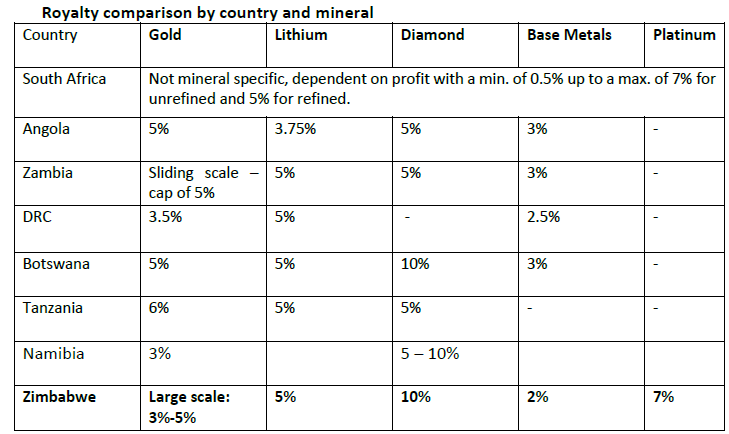
Lithium miners used to pay a royalty of 2.5%. This was increased to 7%, as government sought to cash in on high prices. However, lithium prices have since fallen from US$81,000 per tonne in November 2022 to just over US$10,000 a tonne today. This has happened just when lithium mines in Zimbabwe are “still facing huge start-up costs and are yet to recoup their investments,” the Chamber said, “compromising on the viability of lithium projects.
For lithium, miners propose:
- A base royalty of 5% for lithium prices of up to $15,000/tonne. Miners would pay this even if lithium prices fall.
- A royalty of 7% for prices between $15,000-$20,000 tonne
- A royalty of 8.5% when lithium prices go over $20,000 tonne.
Miners have a similar plan for platinum: A royalty of 3.5% up to US$1,100 an ounce, rising to 5% for US$1,100-US$1,400, 7% for $1,400-$2,000 and 8.5% for prices above $2,000 an ounce.
Power
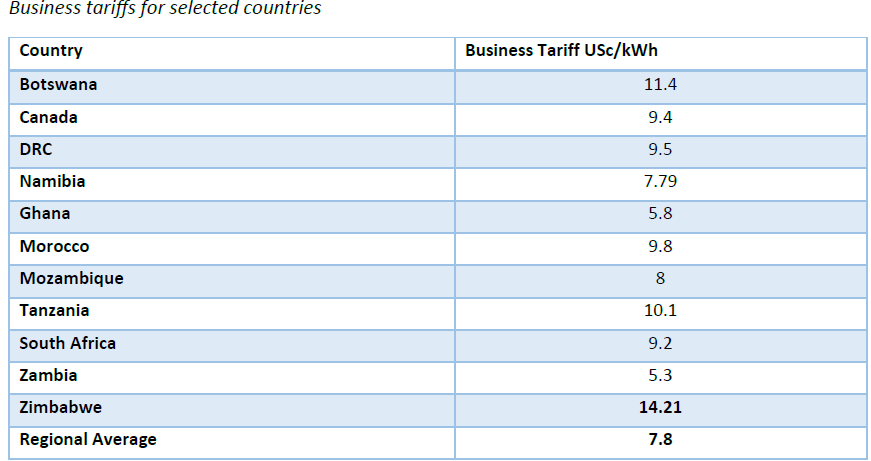
ZESA charges mines 14 US cents per kWh and a peak tariff of US19 cents per kWh, the highest tariff in the region. Mines want this cut to US9c/kWh. To increase power supplies, the miners propose incentives for independent power projects, and that ZESA release companies from long-term power supply contracts.
Forex retention
Miners get 75% of their earnings in dollars, with the rest paid in ZiG. Because the local currency loses value, the companies lose money on the 25% portion. They say this is “a direct cost and is akin to a tax on exporters’ gross proceeds”. They want the dollar portion increased to 85% to match costs. They also want to be allowed to pay more of their government fees and taxes in ZiG.
Mineral export tax
The government plans to charge 5% for any platinum exports that are not fully processed. Miners have previously said there was not enough production to justify a refinery. Platinum mines currently process platinum into mattes, which are sent to South Africa for final refining. Government has been postponing the tax for years to give miners time to build refineries. Last week, the Ministry of Finance said there would be no more postponements. Zimplats is currently working on its $179 million refinery, which will process platinum from other miners. Construction has been delayed because of low prices. Miners are asking for a further postponement of the tax to give Zimplats more time.
ALSO READ | New survey: Miners’ confidence is up, but policy undermines prospects



