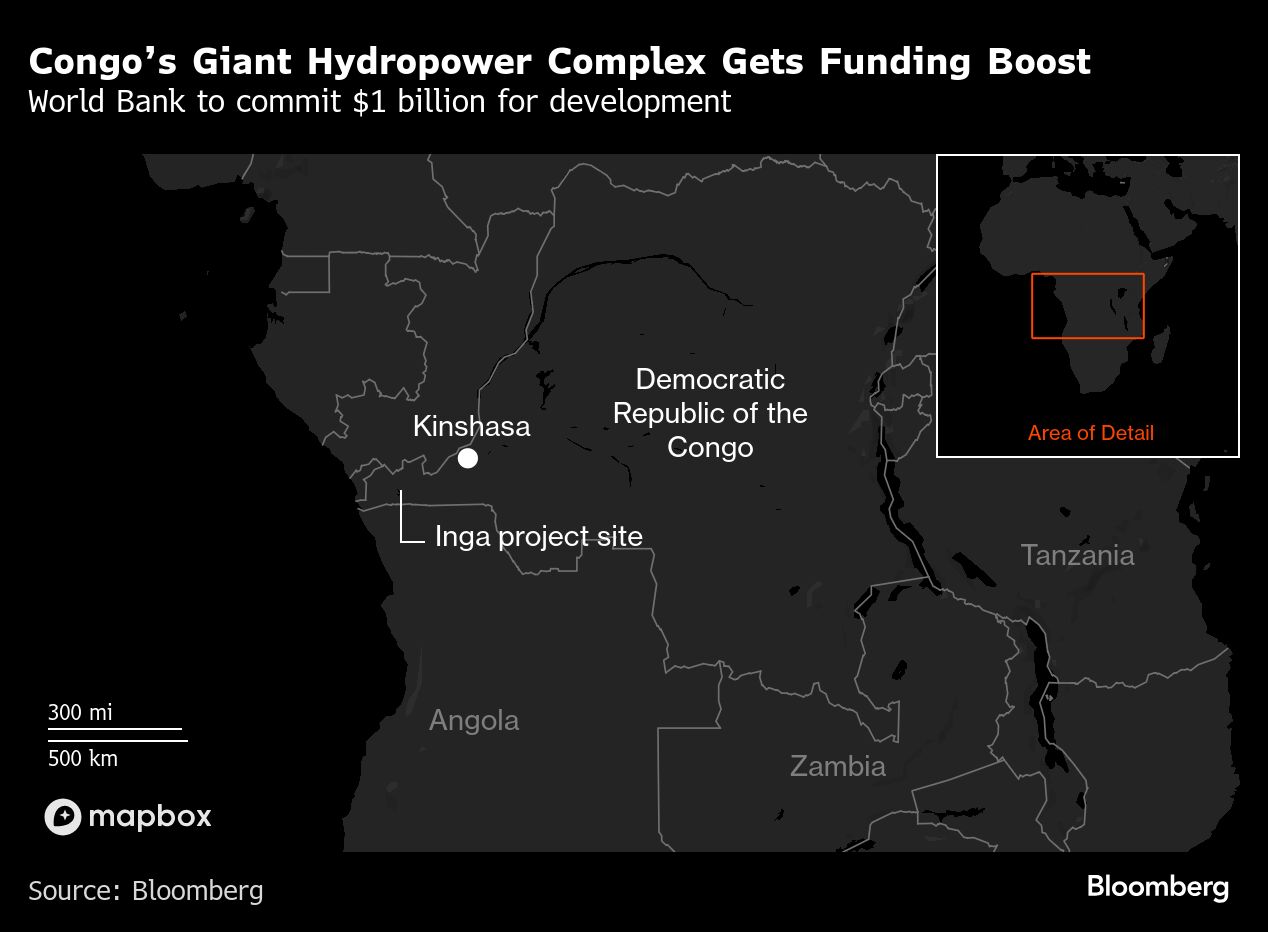


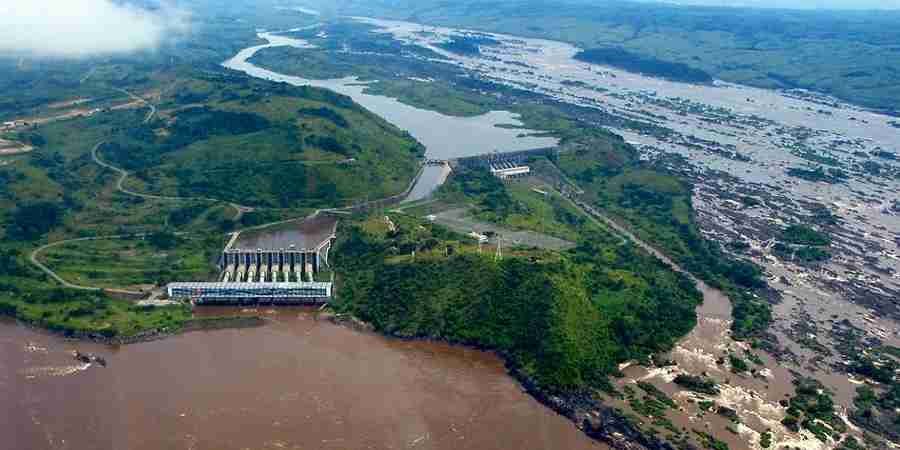
The World Bank said it is committing $1 billion to help the Democratic Republic of Congo prepare for the development of the next stage of what could be the world’s biggest hydropower project.
The bank will initially commit $250 million toward Inga III, a portion of the Grand Inga hydropower complex. The project forms part of the so-called Mission 300 programme, which is backed by the lender, aims to bring electricity to 300 million Africans by 2030 and could attract about $85 billion in private investment, according to Ajay Banga, the institution’s president.
Once complete, the project could generate 11,000MW of power — more than triple Congo’s current capacity — and cost $10 billion. The first tranche of money will be used to fund studies, boost economic development, reform the state electricity company and attract private developers for the facility on the Congo River.
The electricity may be used to support minerals processing, electrify the capital, Kinshasa, and supply other energy-poor countries in the region.
Inga I, an initial 351MW plant, was commissioned in 1972 and the 1,424MW Inga II facility a decade later. Conflict, a history of corruption scandals and prohibitive costs have stalled further development since then.
The World Bank’s funding approach “maximises the chances of Inga III actually happening,” Yadviga Semikolenova, the lender’s practice manager for energy in eastern and southern Africa, said in an interview.
A $36 billion plan to develop Congo’s power industry, which supplies only about a fifth of the country’s more than 100 million people with electricity, was presented at a Mission 300 conference in Dar es Salaam in January and hinges heavily on Inga. Congo’s government has committed to tripling access to power by 2030.
Still, Inga III has had a series of false starts. Last year, the government said it had signed a preliminary deal with Nigeria’s Natural Oilfield Services Ltd. to build a 7,000MW plant at the site and develop an aluminium refinery. That supplanted an agreement with Fortescue Ltd., a company owned by Australian mining billionaire Andrew Forrest, to develop a 40-gigawatt complex that would produce green hydrogen.
Fortescue had replaced a group of Spanish and Chinese companies that failed to develop a $14 billion, 11-gigawatt version of the project. South Africa had agreed to buy power from that version of the facility. It’s unclear what happened to the agreement with Natural Oilfield.
The World Bank itself pulled out of an earlier technical-assistance program in 2016.
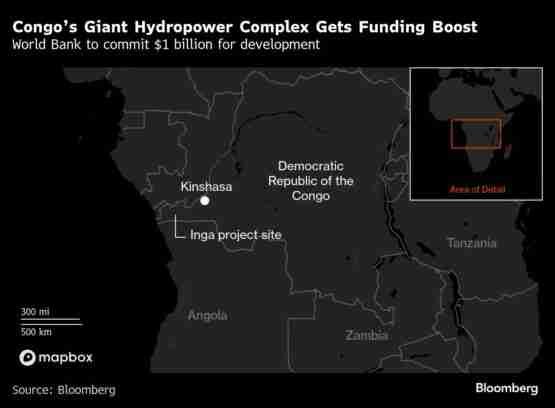
The Inga site on the Congo River, the world’s third-biggest by volume, has the potential to ultimately generate about 40,000 megawatts of electricity. Currently the world’s largest hydropower plant is the 22,500MW Three Gorges project on the Yangtze River in China.
Most electricity currently produced at Inga is transmitted 1,600 kilometres to power Congo’s copper and cobalt mines, which are run by companies including CMOC Ltd., China Railway Group Ltd. and Glencore Plc.
Bloomberg