



Government expects the private sector to fund 60% of crop production this season, as the country lays out an ambitious US$1.64 billion cropping plan to recover from the devastating drought.
This year’s drought, the worst in 40 years, slashed maize output by 70% to just over 600,000 tonnes. The government has ambitions to recover production to 2.7 million tonnes this year and wants more private-sector involvement.
“The estimated financial requirements are USD1,638,792,267.00 equivalent to ZIG 22,108,946,474.10. The government will contribute 37%, while the private sector is expected to contribute 60% through contract schemes, and self-financed farmers will contribute 3%,” according to a cropping plan prepared by the Ministry of Agriculture.
“Private sector participation in production will be enhanced in irrigation development to increase the area under summer irrigation from 75,000 hectares in the 2023/2024 season to 90,000 ha in the 2024/2025 season.”
Zimbabwe freed up grain marketing last year, ending the Grain Marketing Board’s maize monopoly. Since then, private producers have looked to step up their investment in maize production.
The main private sector contractors are Staywell, Innscor division PHI, Delta and Northern Farming. The companies form the Food Crop Contractors Association, which targets to fund 97,000ha this year. This is made up of 45,000ha of maize, 40,000ha of soya beans and 12,000ha sorghum.
Agro-processors are required to source 40% of their raw material requirements from financing farmers, according to government policy. In the last season, the private sector produced 449,300 MT of total cereal production. Some 30% of maize came from private players, the Ministry says.
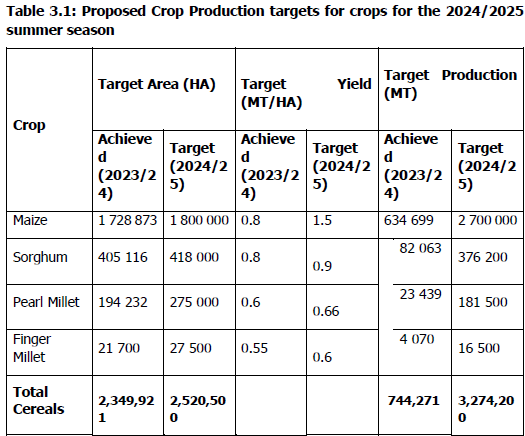
Government also wants the Agricultural and Rural Development Authority (ARDA) to produce 500,000 MT of summer cereals from a 100,000ha irrigable area. ARDA would produce on its estates, with 20,179 ha of arable land on 23 estates. Of this, 2,500 ha is under irrigation.
Zimbabwe has accelerated the rollout of irrigation infrastructure, but progress has since slowed down as funding falls, the Ministry says.
“Cumulatively, the area under irrigation was expected to be 496,000 ha by 2025, but perennial funding challenges militated against the achievement of this plan. A cumulative 48,000 ha have been developed since 2020, against a target of 110 000 ha, a 43.6% achievement,” the Ministry reports.



