



By Perry Munzwembiri
As Food Lovers Honeydew flung open the doors of its glitzy, expanded store, OK Zimbabwe’s shareholders huddled to greenlight a $30.5 million lifeline plan to resuscitate their flagging retail giant. The juxtaposition is almost poetic: one retailer basks in the glow of growth, while another attempts to claw its way out of a financial quagmire. Much like Zimbabwe’s economy, high highs, and low lows. Nothing in between. Pockets of meaningful economic activity on one hand, and abject malaise and stagnation on the other.
OK Zimbabwe’s woes are the stuff of retail legend, a cautionary tale ripe for business school case studies. These problems have been widely publicised, so there is no use belabouring them in this piece. I now turn to the point of this article; an audacious turnaround plan that’s equal parts ambition and desperation. The question isn’t whether OK Zimbabwe needs a miracle, it does, but whether its renounceable rights offer and asset disposal strategy can deliver one.
The Plan: Sell the family silver, beg for cash
For readers that may not be in the know, OK Zimbabwe announced a renounceable rights offer and a conditional asset disposal strategy, contingent on securing sale and leaseback agreements of select properties, to raise capital for a multi-phase turnaround strategy. In its own words, the Board of OK Zimbabwe, claims to have a “bold, deliberate, and well-considered turnaround plan.”
And the rights offer, and disposal of selected immovable assets seem to be the integral pillars of this plan. The funds raised will prop up working capital, fuel capital expenditure, and crucially, placate long-suffering legacy creditors. It’s a classic playbook for a company at an inflection point: sell assets, raise equity, pray for salvation.
But the $30.5 million-dollar question is, will this plan work? Is the market deep enough for rapid sales at full valuation?
First is the matter of the asset disposals. No one will fault this strategy. OK Zimbabwe is clearly in heavy financial distress, and has a handy property portfolio to leverage. When the ship’s sinking, you toss the furniture overboard. Will OK Zimbabwe realise the desired property values quickly in the current Zimbabwean property market, especially for commercial retail space? Some of the properties the Board has identified as having the most probable chances of successfully being sold, include OK Mbuya Nehanda ($3.2 million), OK Glen View ($1.8 million), OK Gweru ($2.7 million), a Birmingham warehouse ($3.7 million) and a stand in Borrowdale ($6 million).
The mechanics of the Zimbabwean economy are such that there is a schism between property values and what is realised upon closing a sale. Take Montclaire Hotel for instance, listed at a lofty $15 million but reportedly sold for a measly $5 million to RTG. The local market is fraught with valuation risk. As one analyst has observed, “asset values are often desktop exercises by valuers, and unsubstantiated by cold-hard facts on the ground.” OK Zimbabwe needs to raise net proceeds of $10.5 million from these sales, and fast. If buyers lowball or deals drag, the turnaround could stall before it even starts.
Then there’s the sale-and-leaseback gambit. It’s a nifty trick: sell the stores, lease them back, and unlock cash while keeping the lights on. However, the corollary is that a huge portion of the company’s cost structure will be shifted from fixed asset ownership (depreciation, property taxes, maintenance burden) to fixed lease payment obligations. Fine until the cash flow sputters.
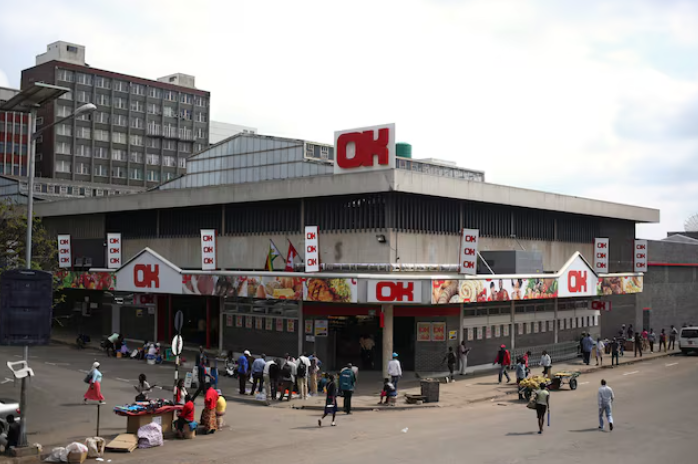
Will OK Zimbabwe be able to generate sufficient cash flows to fund operations as well as these rental obligations? A cursory glance at most of the retailer’s outlets shows generally improved stocking levels. Much improved from the state of affairs not too long ago when images of shelves filled with bottled water went viral. However, these improved stocking levels have not really translated into increased customer footfall in the shops. The retailer isn’t exactly drawing Black Friday crowds. If sales don’t rebound, those lease payments will loom like a guillotine.
Rent will still need to be paid regardless of store performance. Failure will mean eviction, and could leave OK Zimbabwe homeless in its own stores. Not to mention the risks of unfavourable renewal terms upon expiry of the agreements, or the new landlord simply opting to not renew. Whatever the case, if these asset disposals are successful, there is no doubt that OK Zimbabwe’s balance sheet with an approximate net asset value of $78 million will have a drastically different complexion.
Additionally, any future expansion or contraction might be subject to landlord agreements, and the ability to leverage property as collateral for future financing is diminished. Essentially OK Zimbabwe is opting to trade long-term asset control for immediate liquidity.
The Rights Offer: Dilution and delusion?
On the equity front, OK Zimbabwe is tapping shareholders for $20 million via a renounceable rights offer—1.37 new shares for each held, at a 15% discount. The Board has secured irrevocable commitments from 73% of shareholders, with heavyweights like NSSA, Datvest Nominees, and Old Mutual Life Assurance underwriting $16.5 million.
Suffice to say that shareholders opting not to following their rights will experience significant value erosion in the Net Asset Value, closer to 50%. Also, key to note is that some existing shareholders, particularly those already facing their own liquidity challenges, might find the 15% discount mentioned earlier less compelling to follow their rights, especially given the substantial dilution.
The Road ahead: talent, competition, and lady luck
Part of the long-term plan also involves reconfiguring the Board, and infusing new talent in the management team. However, attracting top talent to a company in distress in a challenging economic environment, even with a clear mandate, will no doubt prove to be difficult. While all this is happening however, competition will also be ratcheting up growth plans.
The turnaround needs to be swift and impactful to claw back lost market share. And as has happened time and time again, Zimbabwe’s government has a penchant to whimsically roll out policies that can thwart even the best laid out plans. So much of this plan will hinge on, for want of better phrasing, “luck or good fortune” for the retailer.
The Board is also dangling a carrot for investors: a restored dividend policy by FY2027. It’s a bold promise, dripping with optimism. Investors should however view this as a long-term aspiration, not a guarantee.
The Bottom Line: All in or bust
OK Zimbabwe’s plan is a high-wire act, a desperate bid to cheat the grim reaper. The asset sales and rights offer could provide the cash to stabilise the business, but the risks are as glaring as a neon sign. Property sales could flop, lease obligations could choke the business, and customer loyalty could remain elusive. Yet, with strong underwriting and a Board hell-bent on survival, there’s a flicker of hope for those willing to bet on a comeback.
For investors, this is a speculative play in a market where miracles are in short supply. If the Board and new management can execute flawlessly, restoring supplier trust, boosting footfall, and dodging Zimbabwe’s economic landmines, there’s a chance for value creation. But that’s a big “if.” OK Zimbabwe isn’t just fighting for survival; it’s rolling the dice on redemption. Grab your popcorn.



