



Econet Wireless Zimbabwe shareholders will still be able to trade their shares on a new Over-the-Counter (OTC) platform after the company leaves the Zimbabwe Stock Exchange (ZSE) main board and separately lists its new infrastructure unit, Econet InfraCo, on the Victoria Falls Stock Exchange (VFEX).
The country’s biggest tech company, in a circular to shareholders, says that persistent illiquidity on the ZSE has led to a significant undervaluation of its shares. At the time of its first cautionary announcement on listing Econet InfraCo, Econet’s market capitalisation was about US$500 million. This, Econet says, was less than 20% of its estimated real value, based on valuations of peer mobile telecom companies in Africa. Econet believes it should be valued above US$1.78 billion, given the scale of investment over the years.
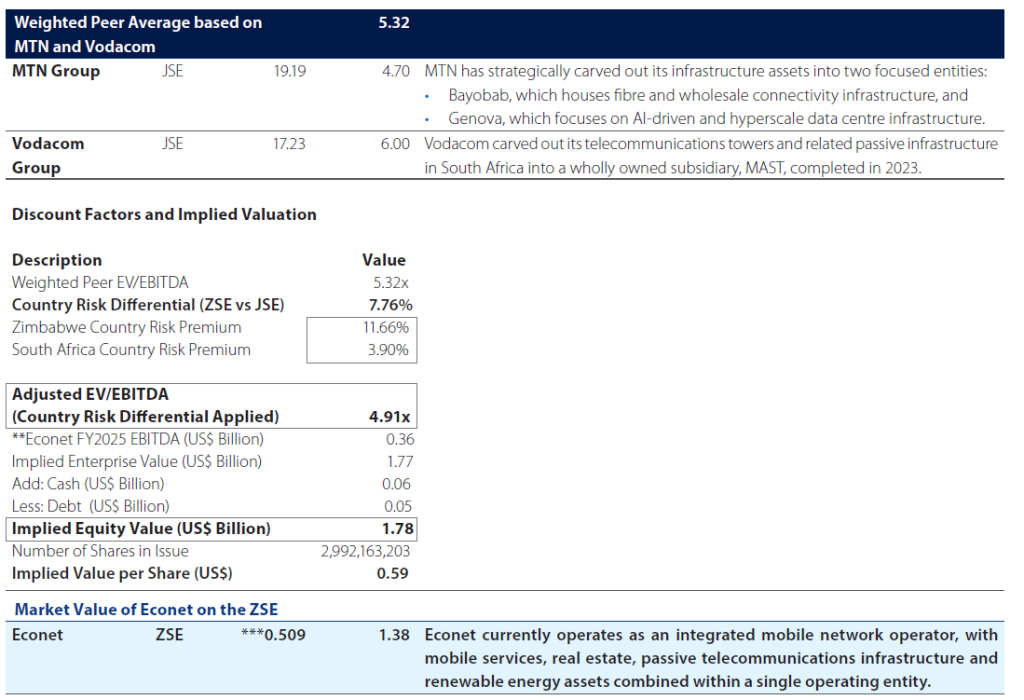
Econet argues that its valuation does not reflect key aspects of its business model, including its continued ownership of tower infrastructure, unlike most African mobile operators, and the reintegration of its fintech operations. It also points to the exit of foreign investors, previously among its largest shareholders, as a major contributor to low liquidity and depressed prices.
This poor liquidity has forced shareholders who want to sell to accept “punitively low prices”, eroding value.
What’s Econet’s proposal?
To address this, Econet plans to transition from the main board of the stock exchange to an OTC system, which will be run by VFEX. This means that Econet will continue to operate as a public company and will continue to produce publicly available financial information.
Under the OTC system, Econet will set a minimum trading price for its shares, based on the company’s fundamentals. Additionally, Econet will serve as the buyer of last resort at a floor price of 50 cents. This price is more than double the current price on the ZSE and more than three times the 90-day weighted average price before the release of the initial cautionary statement regarding the shift to the new OTC trading system. The offer price is as much as 400% higher than some Econet share price points over the past year.
This will benefit all its shareholders, without discrimination, regardless of the number of shares they hold in the company or the number of shares they wish to trade, Econet says.
Econet is to hold a shareholder referendum on February 26 to consider this proposal, as mandated by ZSE listings rules. The proposal being put to shareholders does not compel any shareholder to sell their shares. To the contrary, Econet is urging its shareholders to remain in the company to realise the long-term benefits of being shareholders. Econet InfraCo, which houses the group’s infrastructure assets, is being spun out for a planned listing on VFEX at a proposed US$1 billion valuation. Shareholders would also be able to sell part of their holdings and retain an equity stake.
What is on offer for shareholders who want to sell?
Should shareholders choose to sell and exit, Econet has tabled an offer. The exit offer values each Econet share at US$0.50, made up of US$0.17 in cash and US$0.33 in value through one Econet InfraCo share issued for every Econet share held. For example, a shareholder with 10,000 Econet ordinary shares who chooses to participate would receive US$1,700 in cash, based on the 90-day volume-weighted average price (VWAP), the average share price over the past 90 trading days, weighted by the number of shares traded. They would also receive 10,000 Econet InfraCo shares, with an implied value of US$3,300, reflecting ownership in Econet InfraCo based on an independent valuation.
This is much higher than Econet’s recent share price. “Based on the applicable VWAPs prior to the release of the first cautionary announcement, the Exit Offer represents premiums of not less than 152% to Econet’s 30-day, 60-day and 90-day VWAPs.”
Will Econet still be a public company?
Econet explains what happens after the transaction: “Following the voluntary delisting, Econet will remain a public company and will continue to operate in accordance with applicable laws and good corporate governance practices. The Board will continue to consider dividends from time to time, subject to the Company meeting the solvency and liquidity requirements under the applicable guidelines. General Meetings will continue to be convened, audited financial statements will continue to be prepared and published annually, and ongoing shareholder communication will be maintained through the Company Secretary.”
Shareholders can sell some shares during migration while remaining invested, offering more options to realise value. Stockbrokers will also benefit, as they can trade shares for client portfolios on the VFEX OTC platform and the main bourse, ensuring income protection and the viability of capital markets. With the listing of Econet Infraco, VFEX will see a deepening of its market, at a time the exchange is seeking investor and listing interest.





 trading platform)