
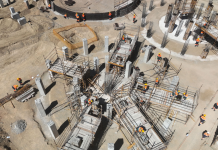



Zimbabwe’s social media is currently at war – this time over a flyover.
The new Trabablas Interchange in Harare has become the latest frontline in the country’s online battles. On one side, government officials are parading it as some grand proof of “progress under ED.” On the other, critics are raising red flags over cost and have called the local engineers involved incompetent.
So, what do the designers and builders say? And how is this project really funded? Here’s a quick explainer.
Who designed it?
Two South Africa-based consultant engineering companies led the design; Ovum Corporation and DNMZ. Ovum was co-founded by civil engineers Nicholas Featherston and Susan Green. DNMZ, formed in 1997, is run by Zimbabwean civil engineers Tendai Madzikanda and Alex Nyoni.
According to Ovum: “The real design work commenced for the project in late 2021, with various investigative site visits being made to clarify the geotechnical conditions, design scope and responsibilities.”
On the completion of the interchange, Featherstone says it was “an awesome project to be involved with”.

___
What do they say about the cost?
According to Ovum, the interchange structure itself cost US$65 million.
“The total cost of the project is currently estimated at US$88 million, which is allocated as US$65 million for the interchange structures and US$23 million for temporary detour works, relocation costs and professional fees,” says the company.
So, how did the cost get to the US$88 million? DNMZ has said its US$65 million cost estimate does not include other parts of the project, which added to the total cost.
“Please take note that for the project implementation of such as complex structure it will involve the following which we were not involved in; relocation of services costs, professional fees of the other consultants, electrical engineers, quantity surveyors, mechanical engineers, EIA specialists…cost of enabling works such as detours and traffic accommodation, compensation of property owners, relocation of people affected by the works, complexities associated with working on live site and payment of royalties for extraction of gravel and aggregates.”
Who built it?
The project is being built by Tefoma, a joint venture between Tensor Systems, Obey Chimuka’s Fossil Contracting and Masimba Holdings. Construction is being done by local engineers, headed by Project Director Lawrence Mberikwazvo of Masimba.
How is it funded?
The project is financed through a vendor financing model — this means the contractor provides the funding to build the project, and the government repays them over time. In February 2023, government gazetted an $88 million loan agreement with the consortium. It matures this week, June 6, just in time after the ‘handover’. The loan was at a 5% interest rate with a grace period of nine months.
Part of the loan is being repaid using funds Zimbabwe received from the IMF’s Special Drawing Rights — a US$958 million COVID-related windfall in 2021. Treasury allocated US$144 million from this to roads. Not all of this went to the interchange, as it was also reserved for the Masvingo highway and local roads rehabilitation under the ERRP projects. Treasury says US$26 million from the IMF money was used as a “deposit” for the project. For 2025, government allocated ZWG100 million (roughly US$3.7 million) towards the interchange.

____
Compensation: Costs and delays
The project was meant to be completed in early 2024. That didn’t happen, mainly because of delays in compensating property owners. Over 90 properties were to be acquired. By late 2024, US$38 million had been paid, covering around half of the claims, a figure that Parliament’s Public Accounts Committee says needs scrutiny. Disputes over property valuations led to court cases and construction slowdowns. Project Director Mberikwazvo says: “We often had to work on just 100 metres of road when we were supposed to be doing 500, because compensation hadn’t been settled.”
Compensation was also hit by allegations of inflated valuations and corrupt officials trying to game the system. In 2024, the Zimbabwe Anti-Corruption Commission arrested a deputy director in the Transport Ministry for allegedly facilitating a fraud of over US$1 million. He was accused of drafting a fake agreement of sale to get government payments.
By the numbers
The project was budgeted to consume 48,000 cubic metres of concrete – which sells at US$140 per cubic metre for the grade used – and 32,000 tonnes of reinforced steel. Cement suppliers included PPC and Khaya, owned by Fossil, one of the contractors. The project features 15 bridges and covers 12 kilometres of paved roads within a nine-square-kilometre radius.
About that odd name…
One final bit of trivia: what’s with the name Trabablas? That’s President Mnangagwa’s wartime nickname. There’s a Cabinet Ministers’ Committee in charge of naming public infrastructure (yes, that’s a real thing). It had settled on calling it the Simon Mazorodze Interchange, in honour of the national hero and the road it connects to. But after all approvals were in place, it’s reported that one Cabinet Minister proposed a different name, Trabablas, in praise of the President. The rest of the committee, as expected, quickly fell in line.
ALSO READ |
With routes to foreign capital closed, B.O.T is now Zimbabwe’s preferred avenue for road projects



